


Today’s title about NAS whisky did not emerge by chance. It was actually something brought to mind by last week’s review of the Springbank 100 Proof. Proudly aged “only” 5 years. And yet, the very same distillery has another 100 Proof whisky, the Longrow, which does not have an age statement on the bottle. In pure Springbank confusing-labelling-decisions fashion, the age info is out there (for the 2026 edition at the time of writing) on their website. Which, in my book, makes the discordant age-labelling decision a classic example of Springbank not caring about what anyone else thinks. Take them or leave them. They won’t change.
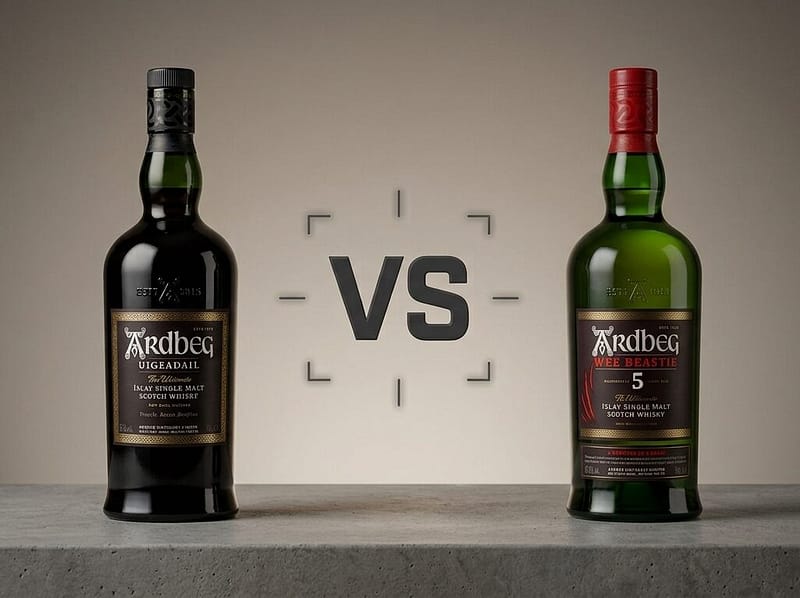
Springbank is not the only one in this category. Ardbeg -which I picked as this post’s title image- is another good example. The Wee Beastie is unapologetically labelled 5 years old. Uigeadail and Corryvreckan are NAS. Why? I could wager a theory, but it would be a very cynical one – maybe another time.
The use of NAS vs age statements is something that has been bugging me for some time. To spare you the suspense, I see points both for and against distilleries’ continued use of NAS. I do, however, have an opinion on where I’d love the market to move to, and to get that, you’ll need to get through the article. Not because I want to avoid a straight answer. But because it is something that makes sense with the proper context, which is what I am about to outline below
How old are age statements in whisky?
Anyone remotely interested in Scotch whisky knows the spirit must be aged a minimum of three years and one day in oak casks before it can be called whisky. Let’s start by dismissing a myth that I still hear from time to time . The one on the role the Immature Spirits Act of 1915 played in establishing ageing for whisky. You will sometimes hear the (erroneous) claim that this was the act that started ageing and age statements in whisky. It did not – it just established the minimum ageing period.
The law was not established out of quality concerns. It came about because of the push from the temperance movement to reduce drinking among the UK population during World War One. The law essentially removed the option to market cheap, unaged or quickly aged spirits. By adding a cost (ageing and stocking) the law would slow down the flow of young spirits and increase the price of cheaper options. (Ironically, the UK is still struggling with cheap booze and minimum alcohol pricing over a century later.) But that is not where it started.
Ageing as consumer value
Ageing had long been seen as a way to produce higher quality whisky. And ageing was already common for higher quality spirits well before the 1915 Act – even though its exact length was often not explicitly stated. In the 19th century, blended whiskies were the main product consumed. David Stirk, in his great and greatly geeky book Whiskyopolis about Campbeltown, reports a fitting quote. James Greenlees, one of the key whisky figures at the time in Campbeltown, who in 1891 claimed that:
“People want a much more silent and much older whisky than they did 10 or 15 years ago”
That was while speaking to the Select Committee on British and Foreign Spirits. And looking at the scene of the time confirms that. Products like Johnnie Walker, Dewar’s White Label and Ballantine’s (just to name those still on the market today) were initially mostly non-age-stated. They eventually used specific age statements for top-of-the-line products. But the use of “Fine Old” or “Matured Whiskies” was commonly mentioned as a sign of quality even in standard blends.
Ageing was clearly popular well before 1915 and before single malt became popular.
Age statements and single malt
Intriguingly, the first broadly and actively marketed single malt was a non-age-stated one. The milestone-setting Glenfiddich straight malt launched in 1963 had no age statement, although it quickly gained an 8-year-old statement by the end of the decade. 8 years was a pretty common age statement in the 1970s. Brands like Macallan, Aberlour, Glenlivet, Highland Park and more all offered one during that decade. (Browsing all those whisky auctions was bound to be useful at some point!). So where did the 10 and 12 year old age statements come from?
While there are examples from the 70s out there, their explosion is suspiciously coincident with the Whisky Loch. And in a way it makes sense. What do you do when you have a lot of unsold stock in your warehouse which keeps ageing? You boldly place that double-digit (10, 12 or even 15) age on your “entry” bottle, implying superiority vs those young sub-10 year old malts. Between the late 80s and early 90s, the 10 and 12 year old age statements had become “the standard”. A standard manufactured by the whisky producers, not by the consumer.
Ageing clearly developed as a consumer preference, allowing it to mellow the fiery character of young new make. In a way, the use of an age statement (always indicating the youngest component in a vatting) was a sign of transparency. A guarantee of sorts to the consumer – that is an important concept we’ll come back to later. But it was never meant to be a defined industry-set numeric value under which a whisky is “inferior”.
The return of NAS whisky
Seen in that light – age as an industry-defined line in the sand – the decision to bottle whisky as NAS could be seen as an act of rebellion against conventional thinking. As is often the case, that is true, in part, but reality is a bit more complex.
And as we’ve seen, NAS used to be the default in the blended whisky age, with age statements more of a top-shelf exception. In a way, we have gone full circle: today NAS whiskies are as common as age-stated ones. How did we get here?
In part, just like the Whisky Loch times, demand is the driver. After demand grew again in the 2010s, distilleries found themselves with less aged stock than the market asked for. The release of younger stock became a necessity, and with that the number of NAS whiskies increased. Why not release those with a younger age statement? Because the industry had become a victim of its own age statement success. If you have pushed 10- or 12-year-old whiskies as “the entry level”, how can you now go back to 5- or 8-year-old bottles without it being perceived as a drop in quality?
The NAS corner: fighting regulation… and some malice
There is a believable justification and case for going NAS. Rebelling against the restrictive definition of age contained in the Scotch Whisky Regulations 2009, which states that:
“age may only be specified in the description, presentation or labelling of a spirit drink where it refers to the youngest alcoholic component in the drink.”
Imagine you are vatting a single malt made of 18-year-old spirit and “by mistake” you add some 3-year-old spirit. (Any reference to Living Souls Ninety-nine & One is absolutely on purpose). You are now forced to label it either a 3-year-old or as NAS. The latter seems like the obvious choice.
While I understand the logic of the regulation as consumer protection, the way it forces age statements to be only linked to the youngest component is not only draconian but also, ultimately, an enemy of transparency. Even more so when the SWA’s own interpretation of not disclosing vatting components on whisky labels comes into play. That famously came into play against Compass Box, to prevent it from disclosing too much information! The fact that the complaint came from “an unidentified member” of the SWA tells you all you need to know. This is not about customer protection; it’s about industry interests.
That’s when marketing uses NAS to blur the lines of liquid quality and availability and price. It’s when the label is used to sell young and often artificially scarce products under the opaque NAS definition. Macallan’s limited collections immediately come to mind. When I see Scotland’s third biggest distillery by volume release NAS whiskies marketed as rare and pricey I cannot help but be cynical and see someone using NAS as a smokescreen to justify the price of something that is neither scarce nor that old.
You might be under the impression that nothing seems really new in the world of Scottish whisky. Yet, it is also true that nothing really stays still.
The Zeitgeist shift…
In the past 20 years, Scotland has seen a new wave of distillery openings. Just in the past 15 years, about 50 new distilleries have been established (based on Wikipedia’s latest info). Many of these distilleries have been keen to make a name for themselves early on. That is necessary both to establish their place among whisky consumers and fans, but also to start seeing some revenues after years of investments and red balance sheets. That has translated into a new wave of younger spirits like Lagg’s Kilmory and Corriecravie, three and three and a half years old respectively, Ardnahoe’s Inaugural Release, at five, and many others.
While not all of these young releases have been a hit (some like Lochlea’s Fallow 1st edition were definitely too young for my taste), most showed that young whisky can be delicious when treated right. I think Glasgow Distillery has been one of the best in that aspect. By using active casks to provide tons of character to their bold spirit. And with that new wave of younger spirits, we have also seen a change in attitude to age statements and ways to be more transparent.
Some distilleries, like Glasgow for their small batch series, not only provide an age statement, often only 4 or 5 years old, but also the bottling date and the length of ageing in each cask type. Others like Lagg decided to bottle as NAS, bu are opent about the age of their spirit if you ask. And then there is Ardnamurchan.
…and how technology impacts age statements
If anyone has shown how a distillery can be transparent to consumers about their spirit and shown the industry how digital technology can move away from the antiquated and stiff rules of the SWA, look no further than Ardnamurchan. Although their whisky is almost always – technically – NAS (except the 10-year-old), the information is openly available. By employing blockchain technology, you, as the drinker, can see all the production details for the bottle you are drinking. Not only the age of the spirit and casks used, but also info on the barley, mashing, fermentation and distillation. Check out one example here if you wish. You couldn’t ask for more as a consumer.
Using blockchain is an investment, and production needs to be set up to support it. Not everyone will have the resources or desire to deploy such a technology. But it is a strong signal that there are alternatives to the black-and-white age vs NAS separation.
Ultimately, when it comes to aged or NAS, I do not feel one is intrinsically better than the other. What matters most is transparency, because that gives me the tools I need to decide if your price is worth my attention. And that, in the end, is what it is all about.
An appendix
One question remains unanswered for now. As the spirit of the wave of new distilleries matures, will we continue to see these younger spirits we can buy today, or will bottlings move progressively to older stated ages? Considering the current slump in the industry, we could see a repeat of the Whisky Loch playbook.
I hope that they do not, at least not fully. My hope is that, in the next 10-15 years, we will see many new distilleries on the market with 10-, 12-, 15-, and 18-year-old bottles. (Or maybe 13, 17 and 23 like Craigellachie; I do like prime numbers). That would mean that the industry has come through the current slump stronger.
And a call for bravery
First of all, I hope the industry continues to offer younger spirits in the future. There is some ingrained age snobbery in the whisky world, a snobbery built by the industry and believed by many whisky geeks. A snobbery that borders on age-fetish, and one I reject. I have had great whiskies both young and old, as well as disappointing ones, also both young and old. Fiery, unripe, almost undrinkable young spirits. And dead, flabby older bottles too. The main difference was the price of the disappointment. Relatively cheap for the first one, extremely dear for the latter. As a consumer, I ultimately want to have an exciting drinking experience. And a good young whisky can be a lot of fun: last week’s review, the Springbank 100 Proof 5-year-old, is a great example of that.
But I also hope that the industry shakes its cobwebs when it comes to age statements and transparency. And takes the bold stance of seeing age as a signal for what to expect in the glass and not a marker of quality. And transparency as a must.
My second hope is around transparency and care for the consumer. Let’s be honest: we live in an era of encroaching enshittification, where the consumer is viewed as a means to profit, not as the customer to be served. Think dynamic pricing or subscription models. And in whisky this translates to premiumisation, especially when applied to NAS, where lack of transparency creates that grey zone that allows inflated pricing to exist. Any distillery that goes against the grain is one I am willing to support, be it the hyper geeky level of information we get from Ardnamurchan or the old-fashioned, matter-of-fact info Springbank champions.
Doing that takes some bravery. The courage to think customers are people who matter and not just a wallet to squeeze. There are enough examples of new and old distilleries doing this – hopefully the market pressure will not change their ways.
If you have enjoyed this content, please share a comment below and consider supporting the cost of this blog via the button below


