


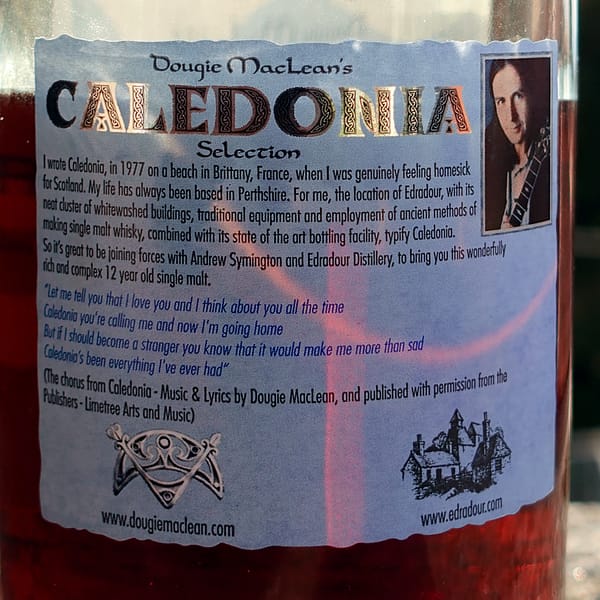
Today’s review looks at the Edradour Caledonia. This post is part of my Fork in the Road series. Bottles I could have picked during my original Road to Dram journey but were excluded in favour of others, usually better-known bottles, or, as today’s pick, whiskies more usually associated with a specific style. Which, in today’s case, is funky single malts.
Return to funk
I love funky whisky. The number of reviews I dedicated to them betrays that love when I look back at my archive. Although I don’t care much for Scottish whisky regions and their supposed archetypal styles, it is undeniable that Campbeltown is strongly associated with that description. So, it is perhaps unsurprising that after two recent Springbank reviews, the 100 Proof and the revisited take on the 10-year-old, my thoughts wandered to funky whisky again. Neither of those two recent reviews focused specifically on funk, to be fair (the original Springbank 10 review did to a certain extent). But not everything I am thinking makes it on the screen (or page?). It just waits for the right moment sometimes.
What is funk?
If there ever was a million Euro/Pounds/Dollars question in whisky, that would be my pick. The Cambridge Dictionary and most dictionaries define it as:
having a bad smell
Intriguingly, it also defines the adjective to mean “fashionable in an unusual and noticeable way”. But that does not match its common use in whisky. Bad smells are generally described as off-notes.
In common whisky parlance, it is probably fair to say that it blends the two concepts. Most of us commonly write or say funky when a whisky has an unusual smell outside the realm of “typical” grainy, fruity, sweet, spicy and floral smells, but something which also provides character and complexity to a whisky.
There is no single funky descriptor. The potential range is broad: grease and machine workshop, cheesy and lactic, yeasty, soapy and woolly, farmyard and compost, vegetal (especially cooked), sulphuric and more. Even Clynelish’s famous waxy note fits the description. And yet not all of these are always referred to as funk. The farmyard and workshop notes of Springbank and Kilkerran are. The lactic note in Ledaig sometimes. The soapy notes some of us get in Deanston, or the sulfury, meaty notes from Sherry cask ageing? Usually neither is labelled as funk. But maybe they should all be, and the reason behind it requires a bit of science.
Where does funk come from?
Before I start, I need to put a few things straight. This is not a strictly scientific explanation; I tried to keep things as understandable to a lay audience as possible. While I do have a biochemistry background, which certainly helped in investigating what funk is, I decided to keep the geekery at a minimum. Also, I am no distillation scientist or pro, so what you will find below is what I managed to collect through my own literature (both technical and non-technical) research. Happy to be corrected if I missed something.
Considering all the potential funky aromas, it is not surprising that the various funky notes have a variety of origins. I am simplifying somewhat, but there are three main players in funk: fermentation, distillation and ageing.
Malting and Fermentation: potential funk
One of the main families of compounds responsible for funk comes from malting itself. It starts when S-methylmethionine (SMM) forms in the barley during germination. When the grains are kiln-dried to stop germination and create ready-to-ferment malt SMM converts into Dimethyl sulfide (DMS). Longer germination times and/or higher kilning temperatures produce more DMS, which carries grassy and cooked vegetable notes.
Yeast also contributes to this chain. It reduces sulfates to hydrogen sulfide (the famous rotten eggs smell), which, through a series of reactions, can produce DMS and two other sources of funk, dimethyl disulfide (DMDS), and dimethyl trisulfide (DMTS). DMDS and DMTS are often responsible for heavier sulfur notes like rubber, struck match and meat/bouillon cubes.
But that’s not where it stops. A lot of the compounds which give funky notes are formed during fermentation. At times these are byproducts of normal fermentative processes. Longer-chain fusel alcohols (grease, machine workshop), medium- and long-chain free fatty acids and their esters (caproic/hexanoic, caprylic/octanoic, capric/decanoic) giving wool and wax notes.
Sometimes it is a matter of amounts: some medium-chain fatty acid ethyl esters can turn from fruity to soapy when their concentration increases. And at times the notes come from bacteria working during the fermentation, especially when these are long: lactic, cheesy notes are often linked to Lactobacillus and related bacteria.
At this stage, the funk is only potential. It will only carry to the spirit if it makes it through distillation.
Reflux: the funk gatekeeper
If you have spent even a minimal amount of time trying to understand whisky’s production methods, you will have come across the concept of reflux and how this decides how heavy or light a spirit is.
High pot stills, boil balls or restrictions in the still’s neck, flat or even ascending Lyne arms and tube and shell condensers all tend to give a lighter spirit. This is due to the increased contact between spirit and copper, which reduces the amount of heavier compounds making it through to the new make spirit. Squat onion-shaped stills, descending Lyne arms and wormtub condensers give less copper contact and a heavier spirit.
The heavier the spirit, the more larger molecules manage to get through to the spirit receiver tank. And with more heavy compounds making it through, the higher the chance that those funky compounds, if created during fermentation, make it through to the cask. Looking at today’s review, you will not be surprised that the spirit Edradour produces and uses for the Caledonia is a heavier one. That is achieved through the use of squat stills and worm tub condensers. Fair to note that Edradour also uses a boil ball and spirit purifier, which have the opposite effect. Whisky is never black and white.
But that’s not where it ends. Some of those compounds might appear in smaller concentrations in the actual new make running off the still, but some solidify and precipitate as deposits (somewhat unkindly also referred to as gunge) in the equipment used. It is widely believed, for example, that this is where Clynelish gets its waxy note from (and lost it, for a few years, when someone decided to clean the gunge).
There is one last source of funk, and it has to do with candles… but not the one you are probably thinking of.
Damned candles
The candles I am talking about are sulphur candles used to fumigate casks, especially wine casks, including Sherry. These candles are burned inside casks to fumigate them before they are shipped to distilleries to age whisky (as well as other spirits). This fumigation is needed because the ABV of wine, standard and fortified such as Sherry and Port, is insufficient to protect the cask from unwanted bacteria, which would give off notes worse than the funk we are talking about, in the cask before it even gets to Scotland.
If used cautiously, the effect is minimal and does not alter the whisky. Yet if the cask broker is heavy-handed, or the cask isn’t the cleanest, the effect can be very noticeable: rubber, struck match, or, worst case, egg in the whisky. That is because the sulfurous smoke is absorbed by the cask’s wooden surface, and it can transfer to the spirit filled into the cask.
For full transparency, some argue that the sulfur candle used is more of an historical thing and rarely used today. I cannot prove either point, but I can testify that sulfur candles are very much available in winemaking supply catalogues even today, for what it’s worth.
There are a lot of rabbit holes on funk I could have fallen into. I hope I managed to provide you with a good overview and starting point, should you want to investigate the topic further. I am definitely more curious about funk than ever before. But it is time to put the theory to the test and review today’s Edradour Caledonia.
Edradour Caledonia 12-year-old
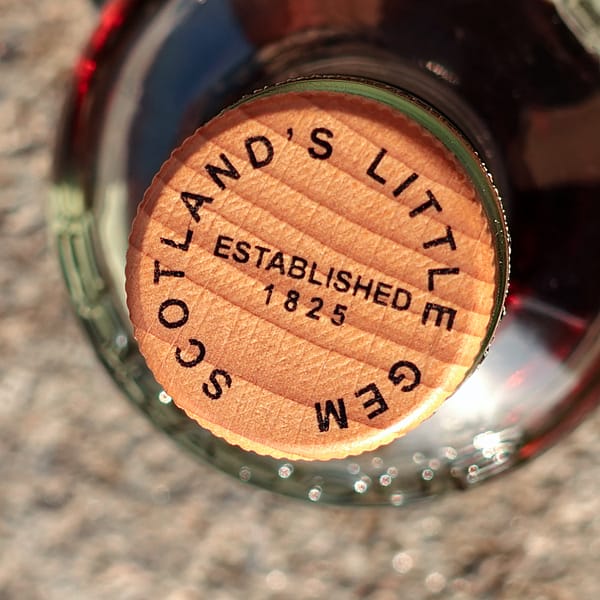
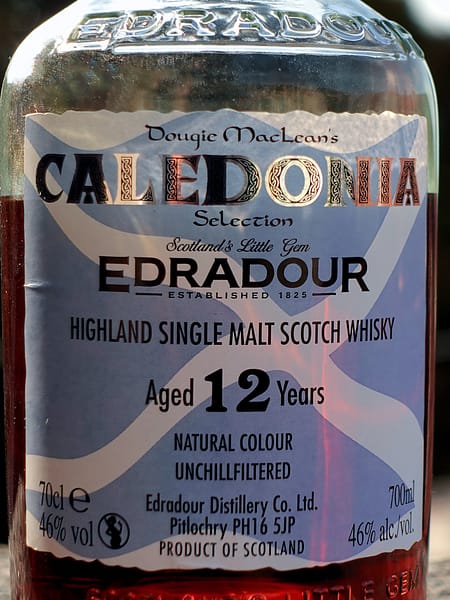
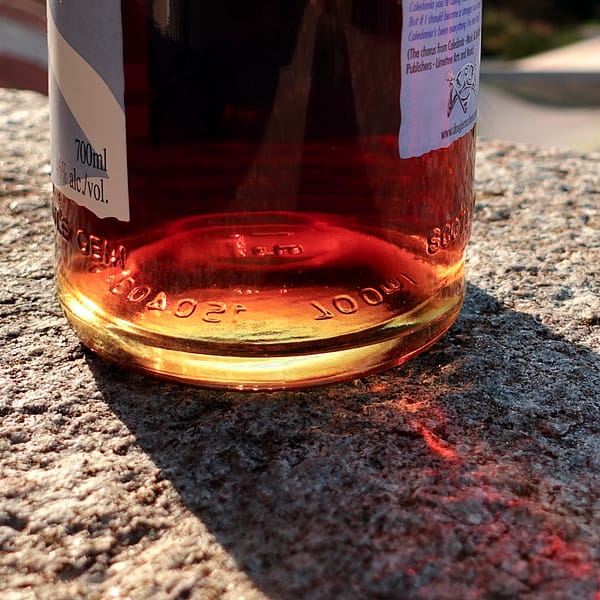
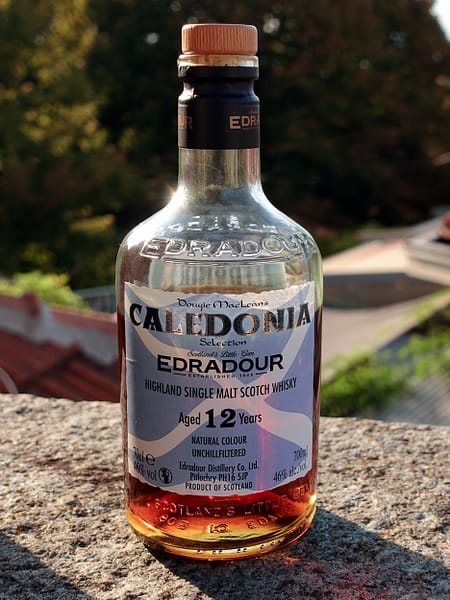
TL;DR: Dirty Sherry: funk without the permission slip.
Score: 8/10, something special
Specs
Price paid: € 76.80 (back in 2024, regularly available around €70 at the date of writing).
Batch: L22/453
ABV: 46%
Natural colour: Yes
Non-chill filtered: Yes
Casks Used: Fully matured in Oloroso Sherry Casks.
Tasting Notes
Colour: Dark amber, just to set the tone on the Sherry cask influence straight from the get-go.
Nose: Very cask-driven. Treacle. Dried cherries and prunes – soaked in rum and coffee. Loads of dark spice: mace, cinnamon, nutmeg, allspice. A touch of liquorice and menthol. Sticky toffee pudding, pecan pie. There’s a punch of fresher ripe fruit behind it all: banana, peach, apple and melon. All dusted with jasmine flowers. And behind it all, a subtle but noticeable sulphury funk: a light note of spent matchstick, a touch of rubber wellies and a puff of forest-floor mulch, with its wet, slightly mushroomy notes.
Taste & finish: The mouthfeel is charmingly rich, but here the cask turns darker. Notes of old polished furniture with that mix of woody and waxy polish smell. Old leather. Candied ginger. Still some light menthol-like note. Everything underpinned by a mildly bitter note. A touch of cooked radicchio. Cold drip coffee, flat cola. At the same time, it is quite warming – again, the dark spices, fudge, more coffee, mocha this time.
The finish is medium, slightly fleeting in texture – it begins full but rapidly thins out. Coffee, spices and polished wood are the closing notes once the last sip is gone.
Score*: 8/10
I have to come clean. Before I even wrote the first line of this review, I knew the score today’s Edradour Caledonia would get. I am a fan and I love those dark, heavier Sherry notes that come out of every one of this whisky’s pores. And yet it still has an underlying freshness and elegance hiding in the background. Plus a properly noticeable variety of funky notes. I am also aware that not everyone will love this. If a more gentle, fruit- and spice-driven take on Sherry cask-matured whisky is your thing, this might not agree with you as much as it does with me.
I personally find it great. A proper, dark, dirty Sherry-aged whisky. Characterful, rich and indeed funky… but not too much.
Would I buy it again? You bet I would!
*Scores are based on the scoring scale used by Dramface, slightly modified to allow half-points
My funk is not your funk, and that’s alright
I started my argument on funk being open about the lack of consensus: there is no single definition of which notes fall into funk and which don’t. So at the end of this Edradour Caledonia Review, you might still be unconvinced. Dirty? Probably. But funky? Maybe not in your book.
You might see those notes as off notes rather than funk. And that is OK. Aromas and tastes are one of the most personal ways to describe experiences because they rely on our individual sensitivity to certain chemicals, but even more because they play together with our experience, memories and feelings.
To me, those rubbery, mulchy and cooked vegetable notes speak of sulfur funk from the malting and fermentation and from the cask. A risky interplay which could have been disastrous but ends up being charming. And, going back to my original fork in the road moment, a reason to ponder that, while Springbank 10 was the obvious and unmissable funky whisky choice, today Edradour Caledonia would not have been amiss among the funky bunch I picked two years ago.
I hope that after reading this post, you will at least consider what funk is in a slightly different way. Let me know if it worked.
If you have enjoyed this content, please share a comment below and consider supporting the cost of this blog via the button below



Funk is what I smell when I open my fridge door since I began to process lots of vegetables through lactic fermentation. I love it.
Thanks for sharing your definition of funk, Ken. I love reading what other people appreciate as smells, much more complex than what “the common wisdom” would want us to think!
Thanks for a very interesting summary of where funk comes from. I too love the Edradour Caledonia. Cheers
My pleasure Nick, glad you enjoyed it!