


After the revisited Glenfiddich 12 and the accompanying Steam & Fire review, I was tempted to follow with a new entry-level bottle. Torabhaig’s new Taigh core release looked extremely attractive. And I love any excuse for a new whisky purchase (especially since it often becomes 3-4 bottles). But then I looked at my collection, and my eye fell on one bottle that might not fit the entry-level label for many, but in a way it represents exactly that in its distillery’s lineup. So rather than a new purchase, I grabbed this bottle off the shelf: today’s review is dedicated to the Springbank 100 Proof, 5-year-old.
The Springbank you won’t need to hunt
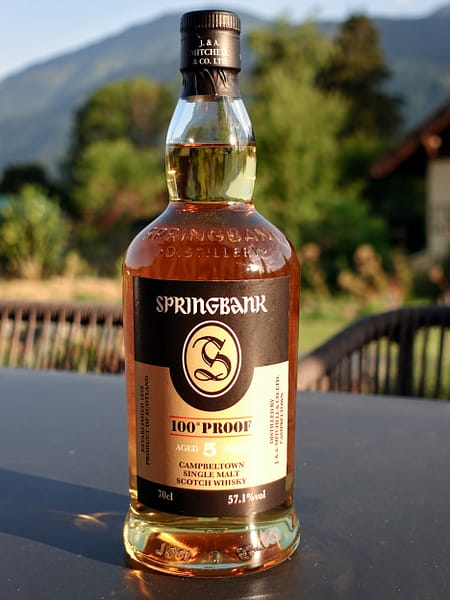
For most whisky fans, Springbank is synonymous with whisky hunting. If you want a bottle, you need to get one as soon as it is released in your local shop (or at the distillery if you are lucky enough to be around). Miss the short window of opportunity, and it is gone. I know it all too well. I am still desperately hunting for a Local Barley bottle on release (rather than secondary). Or maybe, as is the case for some in the US, Canada and Australia, you need to take part in a raffle and hope lady luck smiles your way.
Not with the Springbank 100 proof I am about to review. Aside from a slight rush when it was initially released, this 100-proof release has remained pretty widely available – at least in Europe. A quick look at Whiskybase shows close to 50 shops with availability at the time of writing. That is unheard of for all other Springbank releases. Springbank does not publish an exact bottle count or the specific size of individual batches, so availability may be due to higher production (likely, as we’ll see in a moment) but also to less appeal to collectors. But first of all…
Why did Springbank release the 100 Proof now?
It is a well-known fact that Springbank’s theoretical yearly output and its actual production volumes are significantly different. Although the distillery could theoretically produce up to 750,000 litres of pure alcohol per year (based on the most commonly reported figure), the actual production is significantly lower. That’s due to its use of manual processes and also the fact that the same staff who operate Springbank run Kilkerran for about 12 weeks. There is no official figure on the actual production. Based on this VinePair article, it seems that until 2018 the distillery produced about 120,000 bottles per year.
This explains a lot of the scarcity Springbank has suffered from, especially after its fame exploded during the pandemic whisky boom, with both aficionados and, unfortunately, speculators rushing to grab the available stock. Springbank has moved to increase its production in the past few years, something I heard from staff at the distillery and confirmed by Springbank’s Director of Production Findlay Ross, in 2025, with a reported production for the first half of the year of over 180,000 litres of pure alcohol. While it is hard to translate that to an exact bottle number, it is nonetheless significant growth vs pre-2018 levels.
While the increase in production is aimed at growing the volumes of Springbank’s standard lineup, from the 10 year old to Local Barley, it is fair to assume that the decision to release the Springbank 100 Proof I am about to review was seen as a way to make available to the market some of that production growth ahead of its reaching the 10 year old statement it would require to enter the “classical” Springbank lineup.
A whisky of today, in Springbank’s own logic
There is another aspect which makes the Springbank 100 Proof intriguing as a whisky of its time.
The 100 proof choice for the ABV was, according to the marketing info released by Springbank, a tribute to the old tradition of 100 proof spirits, especially dear to the British Navy. Call me cynical, but I think that is a nice story which hides a simpler fact. In the past 2-3 years, Signatory Vintage has had fantastic success with its 100 proof line, one of which I reviewed at the end of last year. Commercial recognition might have had a bit more to say in picking the ABV than history. The choice of proof for Signatory boils down to the same tradition, so to be fair, Springbank isn’t telling fibs. Just maybe sugarcoating the truth.
The other aspect is that of transparency. We are in an age where many drinkers – myself included – appreciate and call for more transparency in whisk. The more detail, the better. Ardnamurchan’s QR codes and blockchain production info have set the bar very high for anyone else in the industry. I’d never expect Springbank, with its penchant for traditional methods, to follow suit.
Yet, in their own way, this is Springbank being as transparent as they are ever likely to be. For once, both non-chill-filtered and natural colour statements are actually on the label (not a given). Still, more than anything, I applaud the decision to be transparent about the age with the clear and bold 5-year age statement. It is not unique to Springbank. Consider Ardbeg’s Wee Beastie or GlenAllachie’s Meikle Tòir range. They could have easily gone with an opaque not-age-stated bottling and played on the actual age. Instead, they stuck with it.
An underlying message… for those reading between the lines
When I look at the Springbank 100 Proof, I see a very clear message to the whisky world from the distillery. A message that addresses not only the need to increase production to fulfil a growing fanbase, but also one of transparency and finally of purity of expression. Springbank could have dressed their 5-year-old spirit in strong cask influence, from Sherry to more “creative” cask choices. Instead, they went for “plain” ex-Bourbon to deliver something as close as pure Springbank spirit as you can ever expect to get your hands on.
In essence, they delivered a whisky-geek’s whisky: pure spirit, high ABV and with an honest young statement which says this is our distillery identity in its most unadulterated form.
And maybe a reason for its availibility
And maybe that transparency and pure honesty is one of the (positive) reasons this is sitting on shelves for anyone looking. I don’t want to downplay the crisis in which the whisky market finds itself, but other Springbanks don’t hang around – the 10 is starting to be easier to find, but that simply means that instead of disappearing immediately, it lasts for a couple of weeks. It still sells out. This 100 proof doesn’t. It clearly doesn’t appeal to the secondary market as other bottles from the same distillery do. The auction prices I have seen are slightly below retail, never a good sign for bottle flippers. And similarly, shops that decided to play the usual cynical game of ramping up the Springbank price (in this case from the original £50 this goes for at the distillery) are not shifting this off their shelves: who in their right mind would buy a 5-year-old whisky for €80+ when the 10-year-old Springbank sells for below that price nowadays in most shops?
There is a limit to what drinkers are willing to buy on secondary and at what price. Likewise, we whisky fans, for once, are not paying silly prices to greedy shopkeepers who take advantage of scarcity: maybe this Springbank 100 Proof 5-year-oldI am about to review is bringing a bit of sanity back to the game. But that is all jibber jabber if the liquid doesn’t deliver: time to test the liquid.
Springbank 100 Proof, 5-year-old
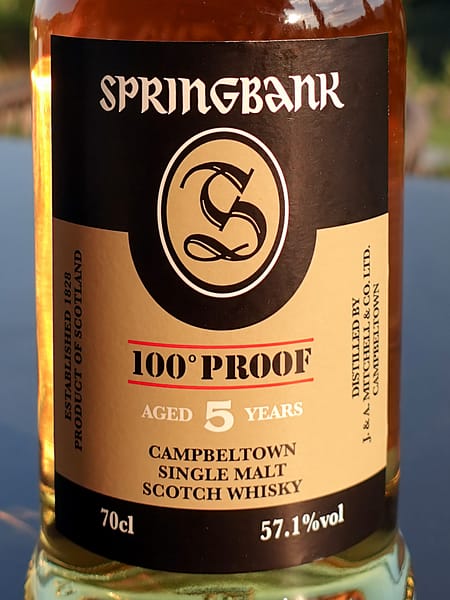
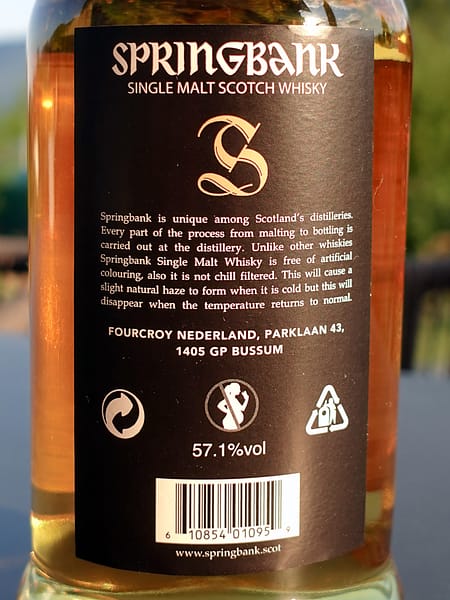
TL;DR: pure young Springbank, and for once not one you’ll need to hunt
Score: 7/10
Specs
Price paid: € 68.05
Batch: 25/100
ABV: 57.1%
Natural colour: Yes
Non-chill filtered: Yes
Casks Used: Ex-Bourbon
Tasting Notes
Colour
Pale straw: exactly the hue you would expect from a whisky aged only 5 years in ex-bourbon casks.
Nose
The nose is intense, as Springbanks tend to be. It comes across immediately as sweet and grain-forward with a touch of citrus freshness. There’s barley sugar, vanilla syrup, malted barley grist, green lemon rind. A touch of acacia honey. Some mild but noticeable spice: some ginger and white pepper. And, comfortingly, a noticeable lick of sooty peat and a touch of Campbeltown workshop funk that underlines the Springbank fingerprint. Right towards the rear there is a weak green minty note, mint tea perhaps, and a faint touch of leather. Overall it manages the enviable feat of being both pretty straightforward in its youthful power and still delivering a level of complexity you could expect in older drams.
Given the ABV, adding some water is a must. A teaspoon or so brings out more fruit – melon, yellow apples – a lot of vanilla (syrup, vanilla whipped cream, vanilla wafers) and ups the funk somewhat. Given a little time, it also becomes noticeably more mineral, and brings out a very clear clean laundry note.
Taste & finish
Oily, as a Springbank should be, definitely on the hot side. It is definitely youthful and unruly. The taste also opens with some young whisky notes in the shape of pear drops and melon. Then there is barley, malted, lightly peated barley (if you ever snuck a couple grains during a Springbank distillery visit and chewed on them, you know exactly what I mean). Cereal, in the form of Weetabix. Vanilla. Some minerality. Then spices, some ginger, peat and a little oaky astringency. The medium finish is slightly bitter, grainy, peaty and spicy.
Adding water does not disrupt the rich mouthfeel too much. It does, however, add sweetness, syrup and vanilla, melon, a touch of ginger, and again pears, this time ripe fruit rather than artificially flavoured candy.
Score*: 7/10
It would be easy to dismiss this Springbank 100 Proof in today’s review as young and hot. And for some this will be a dealbreaker. Not for me: I actually find that younger whisky can have a vigour and exuberance which older whiskies sometimes completely lose, making them lifeless. And I expect that in a 5-year-old. What is important to me is how the liquid reflects the distillery style and whether there is enough in that glass to make me want to go back to it again and again. There definitely is in this 100 proof: it is recognisably Springbank. And even in its youth it delivers a richness of mouthfeel and a complexity of aromas some distilleries never manage to reach. That is a successful young single malt by any account, and the score reflects that.
One question remains: is this Springbank’s new entry-level whisky? Maybe not. I would probably lean towards the 10-year-old as my pick to introduce anyone to the distillery. The 100 proof is a geeky take that might shock newcomers, but for those who love the oily, funky character of Springbank, a sip of this is like coming home.
*Scores are based on the scoring scale used by Dramface, slightly modified to allow half-points
Would I buy it again?
I was honestly slightly sceptical of this one to start. I heard some disappointed takes. So when I cracked my bottle open, I was a bit timorous. I shouldn’t have been. The more time I spent with this bottle, the more I liked it. It is a bottle I will happily buy again – unpretentious, available Springbank? How could I say no?



Maybe it’s a sign of the times, but here in Australia Springbank has become quite easy to find (e.g.https://www.thewhiskycompany.com.au/whisky/scottish-whisky/campbeltown/springbank/?srsltid=AfmBOort6_rX8RL-I3x1NAkipR6CCQJgbQP-jK9nEwTiZ-Z00ud-4gJz). It’s also one of the few brands which dominate our major monthly auction, suggesting many buyers in the past were hoping to make a quick buck, not to drink the stuff. I trust they all lose bigly.
Great to hear that availability is improving – I remember a discussion with a couple of Australian whisky mates complaining about their local lottery chances. And yes, fully agree with you – I hope all the flippers get their commupance!