


After last week’s more reflective piece on NAS vs age-stated whiskies, and where I’d love to see the industry go, it’s time to get back to whisky reviews, this time revisiting Springbank 10. The proximity to the Springbank 100 Proof review is (almost) purely casual. But appropriate for the broader topic I’d like to cover today.
Everywhere you turn in the whisky geek sphere, you will find fans of the distillery swearing that this is THE best liquid distilled in Scotland. No discussion allowed. But I love being an iconoclast, and accepting groupthink has never agreed with me.
So, three years down the line, with a significant range of Springbank bottlings tasted, it is time to go back to the Springbank 10 year old and question whether the hype is real or if we are all buying into a cult?
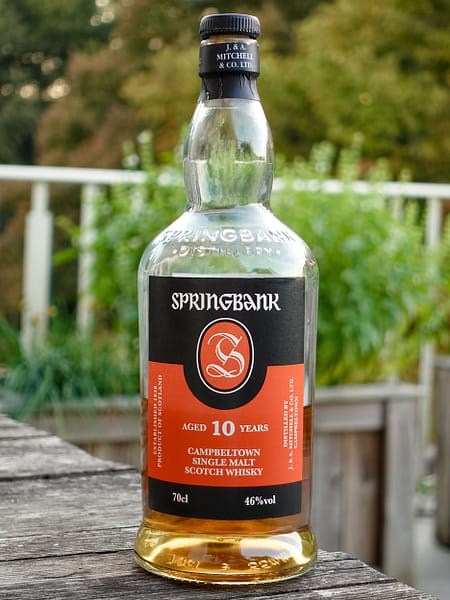
Back to 2024…
When I wrote my original Springbank 10 review in 2024, I made the conscious choice of not spending too much time waxing lyrically about Springbank’s quality, as many others do, but rather to try and find some rhyme and reason behind the love Springbank gets. It was my way to try and rationalise the adoration this Campbeltown distillery gets. And, when you get down to it, those reasons pair with the quality of the spirit but feed into an idealised version of what a Scottish whisky distillery should be.
Springbank’s dedication to traditional whisky-making methods, controlling the whole process on site, from malting to ageing, was one of the factors I spent time discussing. The other was yields. A distillery that could in theory distil 750,000 litres of pure alcohol per year but only makes around half of that, prioritising quality over yield, is one we whisky geeks will easily hype and romanticise. And everything larger, profit-focused concerns tend to eschew. Product quality over shareholder value.
As I stated in that first review, we all need a hero to look up to. A hero who carries the torch of quality over profit. Tradition over social media micro-trends. All that would count for nothing without solid quality. Springbank clearly goes well above that – it pairs value and quality like few others can.
But is it at risk of becoming a cult?
The Springbank Orthodoxy
My light-hearted (as it deserves to be) unease with the blanket adoration of Springbank evolved alongside my whisky exploration. The more time I spent in online whisky communities, the more I became aware of it. It started almost as soon as I dipped my toes in the welcoming online whisky community. Even after just a couple of weeks, I became extremely aware that Springbank bottles were extremely sought after (maybe only trumped by the Ben Nevis 1996 hype). And every time a discussion on the best distillery popped up, Springbank was right at the top of most lists. Nothing wrong with that.
Yet, it started to rub me the wrong way when the occasional “I like this better than Springbank” inevitably got either incredulous replies or friendly jabs. Nothing harsh or unfriendly. Because deep down we are all aware that personal preference trumps everything. But still a soft resistance. The sort of resistance I like to challenge. Nothing like a cult, let me be fair, more of a dogma, like accepting the earth is a sphere. Which BTW, it is not; it is slightly squished… or did you think I was going to say it is flat? Only in Terry Pratchett’s Discworld.
Not every Springbank is Gold
Let me get one thing straight before having a friendly go at Springbank. I love a lot of what Springbank puts on the market. In the past year alone, I have sampled some incredible bottles, both young and old. But I have also had my fair share of just ok to downright disappointing bottles. Like the Port Pipe Springbank Cage Bottle, I scored a lowly 4 in my Cage Bottles flight. Or the one I tried in this year’s Independent Spirits Festival blind tasting.
The tasting, which took place the evening before the official festival, featured a stunning half dozen drams. We, the paying participants, only knew that the age ranged from 10 to 33 years of age, with prices ranging from £50-60 to over £700 (most closer to the latter, as we would discover).
As I went through the six drams with the companions at my table, most of us picked one of two bottles as our favourites (which we later discovered to be a 30-year-old Clynelish from Signatory Vintage and a 31-year-old Glen Garioch from Elixir Distillers, the MacBeth’s Series Angus). One dram left many of us somewhat disappointed: not bad, but thin and tasting a bit flat. Especially compared to everything else in the flight. If you guessed this one was a Springbank, you would be 100% correct. But since I gave it away already, I am sorry; no prize for you. It was a Whisky Sponge’s Whiskyland Springbank 1999.
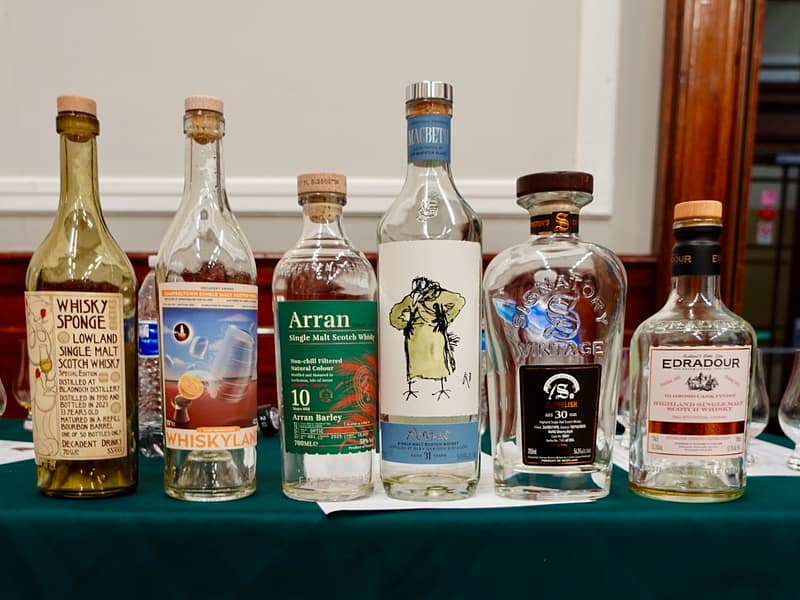
I added the links to each bottle on Whiskybase above because I find the fact that all three have pretty much the same score (89+) exemplary of how much weight the Springbank name carries. When tasted blind, many very geeky drinkers were less than enthused by the 1999 Springbank (though, to be fair, some really liked it). Certainly less than the other two bottles and less than the reviewers on Whiskybase. They sampled it knowing what it was – and the score shows the bias. (Again, for fairness, a couple of people on Whiskybase called out this for being thin. Kudos for the impartial opinion).
While this is all circumstantial, and nothing that would hold up in court, it is enough for me to conclude that it is hard to deny that many of us have a Springbank bias. Which makes me wonder – was my review of the Springbank 10-year-old back in 2024 fair? Was I biased? Or maybe, am I biased now?
Springbank 10 year old
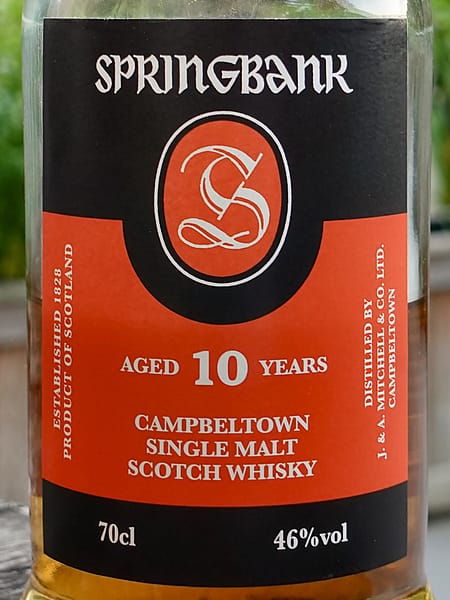
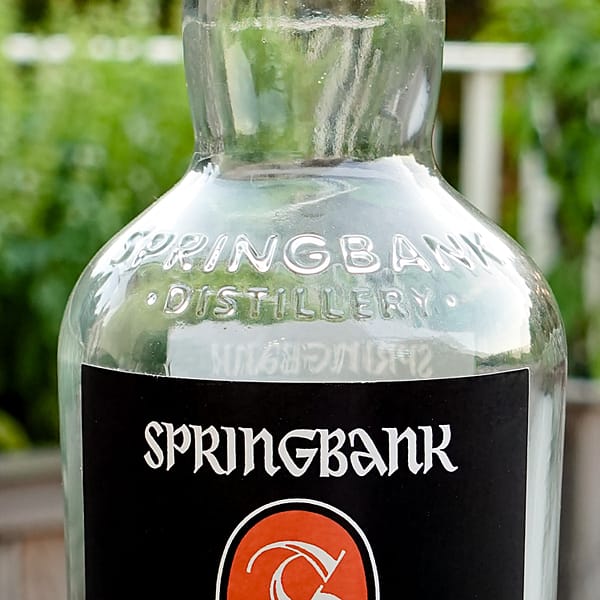
TL;DR: THE gateway bottle to Springbank – rich, concentrated and a bit rustic
Score: 7.5/10
Specs
Price paid: €75
Lot: 22/225
ABV: 46%
Natural colour: Yes
Non-chill filtered: Yes
Casks Used: 60% ex-Bourbon and 40% ex-Sherry
Tasting Notes
Colour: The colour of a field of grain in one of Van Gogh’s famous paintings… seems I am feeling poetic today.
Nose: Unmistakably Springbank, with its fruity, grainy, maritime and slightly funky profile. Lovely ripe, bordering on stewed fruit. Ripe golden apples, pan-fried apple slices with raisins, overripe pineapple, and a touch of strawberry taffy. Then a ton of grain-forward notes: barley sugar, honey drizzled porridge, malt chaff. A whiff of iodine-rich sea breeze. Funk, in the shape of linseed oil and a touch of motor grease. And against those main notes a background of vanilla, ginger and white pepper spice and some green lemon or grapefruit peel and pith.
Taste & finish: Mouthcoating, even velvety texture. Very concentrated in flavour for a 46% whisky. Starts with more of that citrus pith I got at the end of the nose. Mineral. Malt notes, then ripe apples, peach and pineapple. Vanilla. Some ginger. There is just a touch of oaky tannin, extremely fine. Some noticeable funk, in the shape of machine workshop notes and slightly farmyardy notes, giving it a touch of rustic character. Just a hint of woodsmoke peat.
The finish is long, sweet and grainy, with a definite mineral note. Just very slightly tannic at the end but without bitterness
The Springbank Fingerprint
Before jumping to the score, I wanted to wrap up my opening question. Is it hype, is it a cult, or is it justified?
To answer that, I need to get to what, for me, the core of Springbank’s identity is. The one key element that always stands out to me with a good Springbank is the concentration of flavours, especially on the palate. Sometimes, if I have some other 46% whisky before a Springbank, it really feels like drinking full-fat milk after sipping skimmed. The texture difference is glaring. And one that disappoints when it is missing, like in the Whiskyland from the blind tasting. It speaks volumes for Springbank’s commitment to putting quality over yield. It really feels like there is more malt “soul” squeezed into that 46% ABV.
The other character that always jumps out of the glass for me is that “old style” character. Grain forward and funky. Which, in some younger expressions like this 10, always has a bit of a rustic edge to my taste. Some love it. For me it is a bit of a mood thing.
Do I Suffer from Springbank Hype?
Frankly, at the cost of being virtually heckled, I think the J. & A. Mitchell crew have shown us what they can deliver when using slightly more modern equipment at Kilkerran, a whisky line I often prefer. While it does not reach Springbank’s concentration, it is no slouch either and provides a more harmonious drinking experience. At least in the younger range. (Once Springbank reaches 18+, the story is very different, and one best left for another day.)
In a way, my Kilkerran preference is the answer to that opening question, wondering if I have fallen victim to the hype. Nobody has ever come to me on an online forum to convince me I must like Kilkerran. (Someone has done so for Benromach and Kilchoman Sanaig, you know who you are.) Nor has it ever been brought up as a sign of credibility of my whisky expertise (whatever little there is). If my palate were just following the groupthink, Kilkerran would not be the distillery I reach for when I want a whisky treat. Whatever bias I have for any Springbank-labelled bottle isn’t strong enough to override what’s actually in the glass.
And I am glad that’s the case. It gives me peace of mind when I say this 10-year-old Springbank hits the distillery character spot on. It is why it is the one bottle I would start with if you want to begin exploring Springbank. But how does it score?
Score: 7.5/10
I half expected to increase my original 7.5/10 score when I started planning today’s revisited review of the Springbank 10. I know I had been somewhat conservative in the original review, because I didn’t want to be too swayed by the hype. Two years and a few tens of Springbank bottles sampled later, I stand by that vote. This is a very good bottle. Rich, concentrated and intriguing. It is almost special, but just not quite there. At 10 years old, this Springbank still feels it has a bit of the rustic edge that I mentioned before and which hasn’t fully integrated into the whisky. I am nitpicking, but when you are widely considered the best Scottish distillery, a bit of extra scrutiny is arguably justified.
Scores are based on the scoring scale used by Dramface, slightly modified to allow half-points
Would I buy it again?
Yes, and I already have another one as backup. Another one but from a different batch. And that is one of the joys of Springbank. Each batch is undeniably Springbank, but each batch is just different enough to give a slightly renewed drinking experience. Just as batch-variable as a proper, old-style single malt whisky should be.
See you next week for a different take on funk, slainté!
If you have enjoyed this content, please share a comment below and consider supporting the cost of this blog via the button below