


Today I am diving into another Fork in the Road, another whisky that could have been featured in my original whisky exploration but got left by the side. But the time has come to review the Loch Lomond Steam & Fire, a whisky which is arguably a contender for Loch Lomond’s best potential candidate as an entry-level whisky.
When I started the blog, I was set on reviewing the three most sold entry-level single malts, the so-called three Glens (Glenfiddich, Glenmorangie and Glenlivet), first. I wasn’t really looking at other potential candidates in the same category. I really only got interested in Steam & Fire once I started discovering Loch Lomond’s range. But I was aware of it even when I started the blog, and the reason I skipped it is, in retrospect, not one I am proud of.
Looks shouldn’t count… but they do
For me, like for many doe-eyed new whisky drinkers, the range of whisky available was mindboggling. And a bit scary, to be fair. And that was just when looking at official releases. So what did I rely on to choose what to buy? Word of mouth certainly helped, but I still depended on brand awareness. Picking the three Glens as the first reviews, I wasn’t expecting fireworks – I had already experienced the difference that small jump from 40% to 46% ABV can make- but I trusted the reputations that brands had created would not let me completely down. (I was naive; I still feel betrayed by how disappointing the Glenlivet 12 was.)
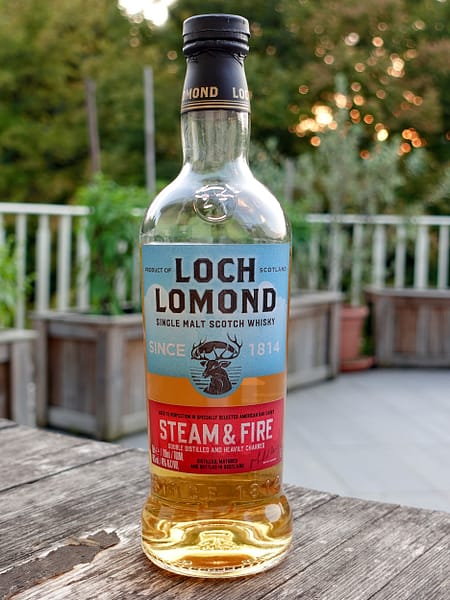
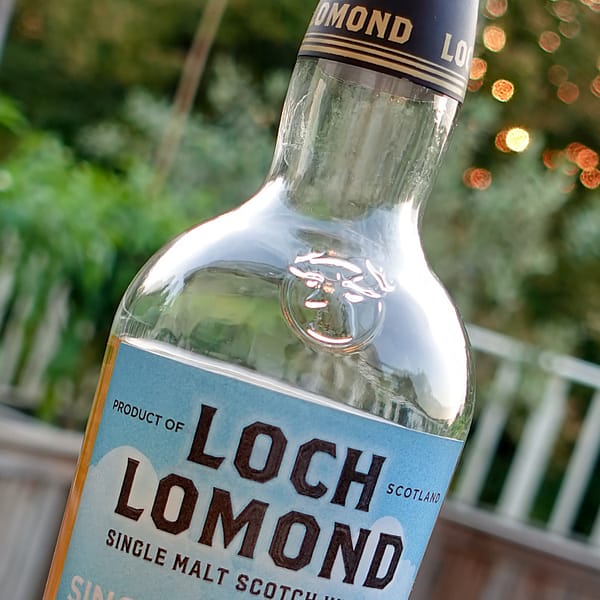
Loch Lomond Steam and Fire was just a blip on the radar. It was released in August 2023 and began appearing in European shops around the time I launched my blog. When I came across it, I didn’t know what to make of it. Loch Lomond was new to me and, based on the word-of-mouth I was getting, a distillery with variable output: some great releases, some just OK. And then there was the presentation. I have learned to love many of Loch Lomond’s releases. Yet, I still feel their labelling makes them feel cheaper. The bold colour and fonts for me always feel like something that should be more at home among a product aimed at teens rather than on a whisky shelf targeting adults. So yes, looks counted more than I would care to admit.
Steam and Fire’s position in today’s Loch Lomond range: Marketing confusion?
The Loch Lomond Steam and Fire I am about to review was originally launched at £45 on the UK market. Not exactly an entry-level price. Nor was entry-level its positioning at launch, especially when the Loch Lomond original, at 40% ABV, targeting the supermarket shelves, was available for about £25. (For the sake of consistency, all prices in this section will be Loch Lomond’s official prices, ignoring the price I paid, as individual retailer and regional prices will vary somewhat around these levels.) If I had to pick a category, I would have put Steam & Fire into the aficionado-friendly every-day drinker category.
That was 2023. With time, things have changed. And significantly so. The price of Steam & Fire has crept lower and lower, and today the official Loch Lomond suggested price is £36. The Original meanwhile has transformed into a three-product line. The three wood at £28, an Oloroso cask-finished version and a peated Rioja cask-finished take, both at £31.
Leaving for a moment the spec difference aside (which I will get back to in a moment), this is the sort of positioning that will leave many baffled. The border between a 40% entry-level whisky and a 46% aficionado-friendly dram becomes much thinner. And the whisky lover in me starts wondering why Loch Lomond does not take the brave step to drop the 40% and go straight to an entry-level 46% line as its foothold in the market. And getting into why that may be the case deserves its own piece.
The value of a couple of extra coins
An extra 5-8 pounds between the Original series and the Steam & Fire might still seem a noticeable price step, but considering what it gets you, it makes the upside so much more enticing. And it touches on a topic which might seem old news to those of us who love whisky, but one which is important to repeat for anyone just dipping their toes in the wonderful world of single malts.
I bang on about wanting whiskies made with at least 46% ABV, non-chill-filtered and natural colour. I am not doing so to repeat a mantra seemingly filled with snobbery. It isn’t. It’s about honestly bottled whisky. Some call it integrity whisky, some craft whisky, but the bottom line is that eschewing these three concepts kills the honesty of any bottled whisky. I also keep banging on these concepts because I have learned that it makes a difference in the drinking experience.
An honestly bottled whisky has a colour that reflects its ageing history, an ABV which enriches rather than dilutes its texture and taste by removing the need for chill filtration for purely aesthetic reasons, and with it eliminating the loss of important texture-giving fatty acids. I will happily pay an extra fiver for that, wouldn’t you?
But the proof is in the pudding. Let’s review the Loch Lomond Steam & Fire and compare it to the Glenfiddich 12.
Loch Lomond Steam & Fire
TL;DR: Enjoyably straightforward
Score: 6.5/10
Specs
Price paid: € 44
Bottling date: 25/05/2023
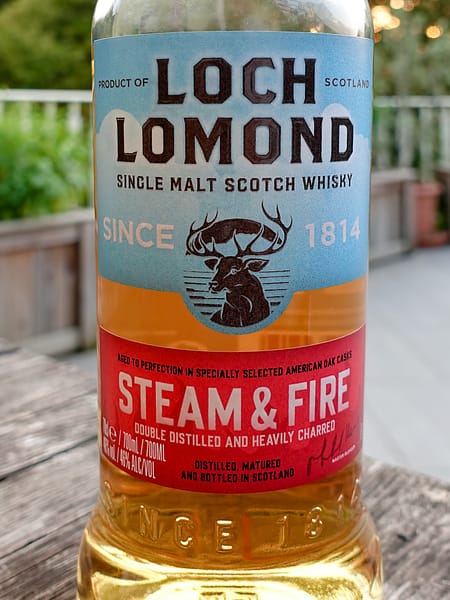
ABV: 46%
Natural colour: Yes
Non-chill filtered: Yes
Casks Used: The official statement tells us it is “matured in three types of American Oak casks before a 10-month finish in heavily charred casks” from Loch Lomond’s on-site cooperage. Thanks to Dramface, we know it is a mix of refill and first-fill ex-Bourbon casks.
Tasting Notes
Colour: Pale gold. We know this is natural colour because it is officially stated by the distillery. But why couldn’t they add that on the label?
Nose: The nose is pretty straightforward but still has some character that keeps it interesting. It opens on white fruit. Green banana, yellow apples, slightly unripe pear. Then malted barley grist and toffee. A touch of peanut shells, something that is more at home in Bourbon than in Scotch. A slightly fizzy citrus note, like lemon flavoured sherbet. Vanilla, unsurprisingly. Right at the end there is just a hint of industrial grease, a mere pinch of Loch Lomond’s 12 year old funk.
Taste & finish: Lovely velvety mouthfeel. Then a bouquet of toasted notes: those heavily charred casks are certainly leaving a stronger mark on the palate. Brown sugar, drip coffee, toasted brioche. A touch of orange marmalade. A big dollop of vanilla. Apples, riper than on the nose, even a touch of peach and orange.
The finish is medium, rich in toasted and toffee notes, ending slightly oaky and bitter.
Loch Lomond Steam & Fire vs Glenfiddich 12
Tasting the two side by side makes for an intriguing comparison (check last week’s Glenfiddich 12 review for the full notes). The nose alone could easily sway drinkers one way or another, depending on each person’s taste preference. The Steam & Fire in today’s review is a punchier, and arguably more modern take, with some intriguing edges in the background. It is arguably less elegant and complex than the Glenfiddich 12. Personally, I could go either way depending on the day.
On the palate, it is a completely different game. The difference is not only noticeable but obvious. Glenfiddich 12 shows the extra dilution to 40% as a weaker mouthfeel and shorter finish. Steam & Fire remains as punchy as it was on the nose and reveals even more edges coming from those heavily charred casks. Don’t get me wrong, this is not a funky or edgy whisky by standard definition. It remains a crowd-pleasing, sweet entry-level sipper.
But while the Glenfiddich 12 plays it safe to appeal to the largest crowd possible, ending with no edges by design, Steam and Fire has just enough of those more edgy flavours to be exciting rather than comforting but uninspiring for new drinkers.
Score: 6.5
After the comparison, you might expect me to give the Loch Lomond Steam & Fire in this review a pretty high score. So the “mere” extra point (from Glenfiddich’s 12 year old’s 5.5/10) might seem a bit stingy. I think it is honest and reflects what Steam and Fire is. A non-age-stated (NAS) whisky that shows a little youthful exuberance, making it far from perfect and a bit straightforward, but still a whisky that is enticing for what it is, especially at its new pricing level.
Scores are based on the scoring scale used by Dramface, slightly modified to allow half-points
Would I buy it again?
So does the favourable vote make this a repeat buy? Not as such, but that reflects more what I like to drink today, after almost three years spent exploring whisky. I might still grab it if I am looking for an easy sipper to share with more casual drinkers. On the other hand, If I had to organise a tasting for new drinkers and wanted to shake their convictions set around more established brands, this would be among the bottles I would pick up.
There are a couple of thoughts that are staying with me as I wrap up this review of the Loch Lomond Steam & Fire. If you are new to whisky, looking for your next bottle to discover: don’t make the same mistake I made and let packaging influence your choices. Trust your guts, your more experienced friends, and take a gamble on something that might not look “cool” on your shelf. You might end up being pleasantly surprised.
After writing my tasting notes, I always find it interesting to look at other opinions. Here are a few other reviews of the Loch Lomond Steam & Fire. I enjoyed:


I love Loch Lomond, but I bet there’s a PhD for a business student who can critically assess their marketing strategy. In Australia the Original is priced at $62, the 10 year-old at $82, and the Steam and Fire at $110. But the 12 year-old is frequently discounted from $96 to $87, and the 14 from $117 to 90-something. I won’t go into the Noble Rebel saga … To add to the confusion, the two or three local retailers frequently offer discounts of 10-15% across the store. It’s all good news for the buyer, but I wonder how long it will last.
BTW if you find the Loch Lomond labels a bit garish, you must hate Bruichladdich bright blue and yellow offerings 😄.
The Australian pricing is wild! Having the 12 cheaper than Steam & Fire makes very little sense to me, but then pricing (and availability) through distribution can get crazy. That’s the same reason why I tend to look at UK pricing rather than pricing here in Italy; every now and then we get some really funky pricing decisions which make absolutely no sense!
BTW… I actually don’t mind Bruichladdich’s branding; it was a very defined identity which hits the spot somehow, even with its bright colours. I don’t love the new Green Stills though, that looks out of place among the rest of the range.