


I likely would not be as passionate about whisky as I am today if it weren’t for peat. In my early days as a whisky drinker, I constantly looked for it and associated it closely with Scottish whisky. It does not surprise me when I hear a new whisky drinker believe that all Scotch has to be peated. In time, I discovered its many facets, peated and not, the various casks, styles, etc. But peat has always played a key role in my journey. Yet I recently noticed something has changed. I turned to today’s whisky, Port Charlotte 10, and the opportunity to revisit it and reflect on how my own taste for peat has changed.
How peat brought me to whisky
I grew up in a household where whisky was my father’s little treat, usually something he would enjoy at the end of a tough week of work. He seldom went for single malts. Johnnie Walker Black and, occasionally, Chivas Regal were his preferred choices. We are talking about the late ‘80s and ‘90s. Those blends, and their quality, were very different from what you get today. Like every normal teenager, I tried to occasionally get a secret sip to feel all grown-up, but I was never sold.
Until the day when, during my time as a PhD student in the UK, I got to taste Laphroaig 10 for the first time. That was a shock to the system. Like being slapped in the face with a bag of burning medical waste. And I loved it. From that moment on, I knew I wanted to learn more about single malts. It took some time before it turned into proper geek passion, but the love was always there. When I decided to start this blog, Laphroaig 10 was one of the first bottles I reviewed (and looking back, I was probably exceedingly generous with it).
Peat still influenced my taste a lot, even though I learned to appreciate non-peated drams too. And in time, I discovered some of my favourite core range peated whiskies – Ardbeg 10, Kilchoman Sanaig and Machir Bay and, more than any other one, today’s bottle: Bruichladdich’s Port Charlotte 10.
My thoughts, back in 2024
When I first reviewed Port Charlotte 10, it hit differently from other Islay drams. It was a discovery among its peers in the core release space. More expensive, certainly, but also more complex, with a profile which balanced peat and spirit better. It made me dance with happiness. So I scored it an 8/10, and from that day it established itself as one of my favourite official drams from Islay distilleries.
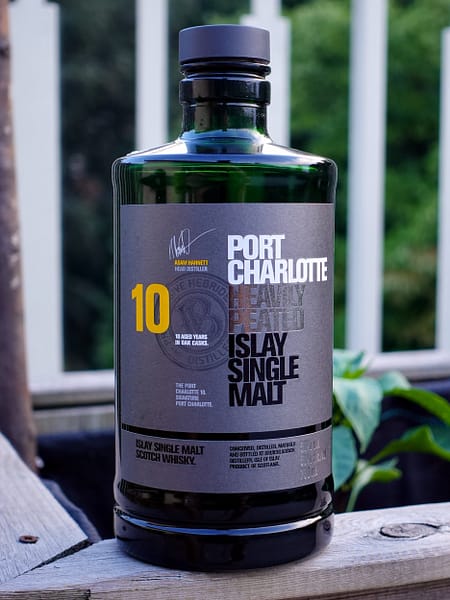
In that original review, I spent quite a bit of the post talking about the difference in the peat Bruichladdich uses compared to many of its peers: Highland vs Islay. An important aspect for sure, and something which deserves its own discussion at some point, but not the core of what made me appreciate it so much.
Yet what hit the spot was the way the powerful, heavily peated spirit integrated into the whisky. Unlike many other “peat bombs”, the smokiness managed to be a note in a wider spectrum of aromas and tastes and not the sole, overpowering character. I just wasn’t fully aware yet how much that would influence my taste in the coming two years.
What I couldn’t foresee
As time passed, I started to notice that I would grab heavily peated whiskies less than before. I didn’t fall out of love with peat. From time to time, the longing for a heavily smoky, medicinal dram hits, and I am glad to have some bottles I can always count on in that style bracket. But I stopped seeing peat as something that needs to have the volume dial stuck on 11.
I started turning more and more to medium peated bottles, think Kilkerran 12 or Benromach Cask Strength. Or to bottles where peat was balanced out by other strong flavours, coming from the cask – Ardnamurchan’s AD Sherry Cask or some of Glasgow Distillery’s weird and wonderful Small Batch releases, like their Marsala Cask. I didn’t immediately think about what was happening. Taste changes, right? We all see our taste evolve, especially at the beginning – when every new bottle can reveal something we had not tasted before. But I am cursed by the need to understand the why of what happens to me.
And what I started realising is that I was beginning to see peat in a gastronomic context – an ingredient to use in building a taste recipe, not the end goal. And like every ingredient in a recipe, sometimes you want it to dominate. Especially if it is your favourite taste. But more often than not, you want it to work together with the rest of the recipe, add its own contribution but not take over. And when you deal with peat, you are dealing with an intensely flavourful ingredient. How much you use, and what you combine it with, has a huge effect on whether it becomes dominating or not.
Wine casks and peat
Seeing peat as an ingredient brought me to a related thought, one I want to settle before I get to the Port Charlotte 10: the use of red wine casks, something that many drinkers instinctively dislike. Yet red wine casks, just like peat, are an ingredient in creating a whisky recipe. And, like peat, they are another ingredient that can easily overpower the core character of a spirit.
Bruichladdich seems to be among the few distilleries that know how to use these casks at their best. Sourcing is key – Bruichladdich uses casks from some of the best producers and regions. They are more often than not used as part of a bigger vatting relying on a core of ex-bourbon aged barrels and usually with a large proportion of second-fill barrels, that is, barrels which have already shed a good part of their flavouring ability and therefore provide a much milder influence. Does it always work? No. I have tried a few of their wine cask series and the results for me have been extremely variable.
So, how does that wine cask influence work in Port Charlotte 10? Time to taste.
Port Charlotte 10-year-old


TL;DR: A complex, peaty, elegant Islay which achieves the rare feat of balance
Score: 8/10
Specs
Price paid: €67
Bottled date: 24/1/2022
ABV: 50%
Natural colour: Yes
Non-chill filtered: Yes
Casks Used: 65% first fill American whiskey casks, 10% second fill American whiskey casks and 25% second fill French wine casks
Tasting Notes
Colour: A deep, rich gold with just a hint of copper.
Nose: Briny, dry driftwood, pebbles. The peat is there as a backbone, but it never becomes overbearing: woodsmoke, a slight phenolic note, almost floral at times. Then the cask contributions, coming in waves. First, sweet vanilla and tablet, the spices – ginger, nutmeg, black cardamom, even a touch of cooking herbs. A hint of red fruits, unripe redcurrant and cherry, soft citrus – citron, stewed lemons. It’s complex yet harmonious, with no note dominating.
Taste & finish: Warm and soft. The peat becomes a touch more prominent, mostly in the shape of woodsmoke, but the sweet, briny character remains intact. Vanilla, lemon syrup, barley sugar. Then ginger, smoked oysters and a light mineral chalk.The finish reveals some white fruit, pear and golden apples, then woodsmoke, pepper and a touch of oak.
Score: 8/10.
No changes in my vote from 2024. Among all the peated entry-level releases from Islay distilleries, it occupies a unique spot. Undeniably heavily peated, yet keeping that power under control, balancing it through a judicious use of cask ageing and a great starting distillate – arguably the best among Bruichladdich’s lineup. And the underlying mineral and maritime notes show that peat does not have to be the only characteristic that can carry an island identity. The wine cask provides accents of spice and fruit with a light hand. Going back to my cooking analogy, it is a recipe which uses its ingredients in a way that makes the whole shine, not just a single component.
* Scores are based on the scoring scale used by Dramface, slightly modified to allow half-points
Does the quality match the price?
Current prices for Port Charlotte 10 here in Italy have stabilised around €70, which is very much in line with Bruichladdich’s online shop price of £60. If you are based in Germany or can order from there, you can easily find it for around €60, and occasionally even closer to €50. It is not a cheap whisky. So is it worth that price? Yes, but with some caveats.
I could make an argument about the Islay tax, i.e. the premium Islay whiskies earn on the market, or its superior specs vs competitors. But that is not what I look at. It’s a timing matter.
Port Charlotte 10’s current price has been pretty stable (at least in my market) for the past 3 years. And that is the problem. Even 2 years ago, bottles like Laphroaig’s 10 Cask Strength would be going for €100, and Ardbeg 10 was often priced around €55-60 (again, here in Italy). But things have changed dramatically due to the slump in sales. Laphroaig 10 Cask Strength is on constant fire sale, with prices dropping below €60 at times, and Ardbeg 10’s price has moved closer to €45.
In relation to its Islay peers, Port Charlotte 10 has become more expensive. Will it remain this way? It is something worth keeping under observation. If Bruichladdich decides to stick to the price even longer and creep towards becoming a premium brand, then my answer will shift from yes to only if you are a hardcore fan. If there is a price correction with a new point set at €50-60, then it would become a strong yes.
A teaser…
Revisiting Port Charlotte 10 helped me understand why my peat taste has changed. Helped find an answer to the why, which I always chase. And, as is often the case when something clicks, it puts things into a sharper focus. That clarity also makes me want to look at other bottles with this newfound awareness.
Which is a great segue to what I have planned for next week. Rather than another Revisited review, I’ll look at one of the bottles which I did not include in my journey. When I got to that fork in the road, I decided to go elsewhere. It’s time to check if that was the right decision, and it might become a regular feature, paired with the revised reviews, moving forward.
I won’t spoil what the bottle is, though it might be pretty obvious due to its popularity. See you next week
If you have enjoyed this content, please share a comment below and consider supporting the cost of this blog via the button below



Very interesting account of your whisky journey. Mine was almost the mirror image! As a young man I liked blends. My favourite was the slightly up-market White Heather (I recently bought a 45 year-old bottle at auction and was quite unreasonably excited. And yes, I still find it admirable). Glenfiddich was the exotic “single malt” just starting to be talked about in Australia (I’m showing my age I’m afraid). For decades whisky was a sideline, if you will, compared to my deep interest in wine. Late last century I bought a bottle of this unfamiliar brand “Ardbeg” on the basis of a newspaper recommendation, and literally poured most of it down the sink as undrinkable.
It’s only been in the last 10 years that I’ve learned to appreciate the glories of peated whisky. After an initial crush when the bar had little but Ardbeg, Lagavulin, Talisker, Caol Ila etc I’ve regained a sense of balance. But if there’s a sensory experience to top the 2022 Lagavulin special release I’d love to get a bottle!
Thanks for sharing your journey, Ken! It is even more similar than this last post would suggest. For years, whisky was a sideline for me as well and wine, readily available and made just a few kilometres away, was my main passion and almost became a profession. Moving to Scotland for a few years for work, oddly , wasn’t the catalyst that turned me to whisky – it was the community and its welcoming spirit and friendliness. Thanks for the 2022 Lagavulin special release tip. I’ll have ot check if there is some still available around – plenty of unsold 2023 and 2024 releases still for sale, often at a discount.