


A couple of weeks back, I stumbled upon the handwritten outline which kicked off Road to Dram and the original journey of whisky exploration. And I realised I skipped one category: whisky made with local barley. It turned into an itch to scratch. Something I couldn’t let go. So today I am taking a short peek into the category with this review of the Kilchoman 100% Islay.
The “Local” Barley Category
Whisky made with local barley, commonly referring to barley grown at the distillery or in the nearby area surrounding it, is a category which holds a special fascination for many whisky drinkers. Not many distilleries follow this path, and maybe rarity is one of the reasons that creates a special aura around these whiskies.
None fits that rarity concept more than Springbank’s mythical Local Barley yearly releases. To be honest, it would have been the ideal bottle for today’s review. But I have miserably failed to source one, missing the drops here in Italy by just a day or so – enough for it to disappear from shelves as soon as it popped up. I could go to auction sites, but frankly those prices are still a bit too crazy for my taste. So it won’t appear today – it remains my unicorn bottle. Luckily, the Kilchoman 100% Islay I picked for today’s review is easier to find and fits perfectly in the category.
But before I go into why that is, there is another question I feel needs addressing. We whisky geeks are fascinated by local barley. Why?
Back to Ye Olde Farmhouse Distillery Days
I think the fascination for local barley whiskies is firmly associated with a romantic ideal of what whisky distilling was in its early days. Or what we believe it was. We have a vision of crofters making whisky with grains they grew on site, using small hidden stills. And we relate modern distillers using local barley, even better if grown on their own farm, as the heirs of that tradition. But as is often the case with romanticised visions, it holds both truth and embellishment. The core of the product might be similar, but the context is very different.
When we romanticise the distillers of old, it is worth keeping in mind the context in which they operated. Highland distillation in the 18th century was essentially illegal (at least according to the British government; I am sure the crofters disagreed). Yet production was often a key financial tool for crofters to pay their rents owed to their landlords. Back then, being caught meant, at a minimum, the destruction of all equipment and stock (and with it the livelihood whisky provided) and potentially prison and hard labour. That way of life began to disappear from the 1750s onward with the Highland Clearances and its fate was sealed by the Excise Act of 1823. Modern distillers might set their minds back to those times, but they certainly do not need to worry about the same risks crofters had to take.
Yet, the core value that tugs at our heartstrings remains. Today whisky making is, in great part, closer to an industrial process than an agricultural one. Which is exactly what makes our romantic vision of local barley whisky appealing; it calls back to simpler and more genuine times. A farm growing barley, used to produce whisky locally, brings us back to a sense of community and of place that modern whisky can seldom satisfy.
Why Kilchoman
I’ll admit to it freely: even with embellishments and all, I am a sucker for that romantic vision. Which is why, once I was resigned to the fact that I couldn’t get my hands on a Springbank Local Barley, I immediately decided that the Kilchoman 100% Islay made for the perfect whisky for the topic. There was another candidate, to be fair, also from Kilchoman.
The new 11-year-old Rockside core range release, named after the distillery’s Rockside Farm location, is also made from 100% Islay barley grown at the distillery’s site. Unfortunately, it has not reached these shores yet, but I am keeping a slot open to review it in the future. Whatever the Kilchoman option, this is a distillery which strongly leans on that concept. It defines itself as “Islay’s Farm Distillery”.
And the name is indeed fitting. Kilchoman grows barley at the distillery’s site, Rockside Farm – mainly from the Publican variety, if the past 100% Islay editions are to be taken as reference. That barley is malted in-house, with a medium peating level, around 20 ppm.
The amount of that malt is limited, so it is mainly used for the 100% Islay editions and, now, the Rockside release. For the other core releases, the distillery relies on purchased malted barley peated to around 50 ppm. Initially, that came from Port Ellen, but since Diageo stopped supplying to third parties, Kilchoman is sourcing its malt from the UK mainland.
The malt is mashed, fermented, distilled and finally aged on site, which truly underpins the commitment to the farm distillery concept. Everything happens in one location.
And why Kilchoman’s 100% Islay 13th Edition
I picked the 13th Kilchoman 100% Islay edition for today’s review due to the cask ageing: fully in ex-bourbon. The bottling is a vatting of malt from 2012, 2013 and 2014 coming from 44 casks previously used to mature Buffalo Trace bourbon, making this nominally an 8-year-old single malt. I like how Kilchoman uses Sherry (their Sanaig remains a favourite), but for the 100% Islay I wanted as little interference as possible from the cask. Because ultimately I want to see if the whole farm-to-bottle cycle comes through in the glass.
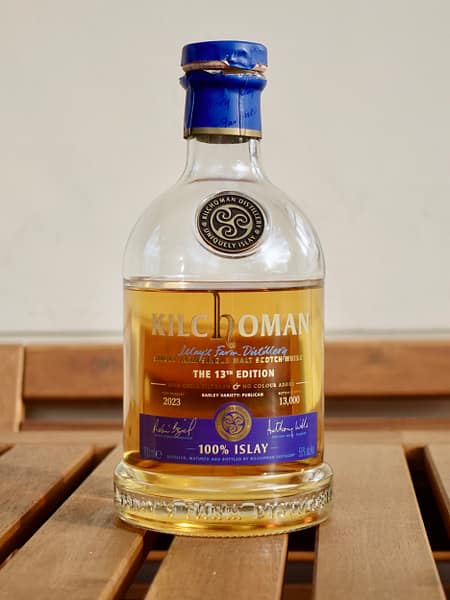
Kilchoman 100% Islay, 13th Edition (2023)
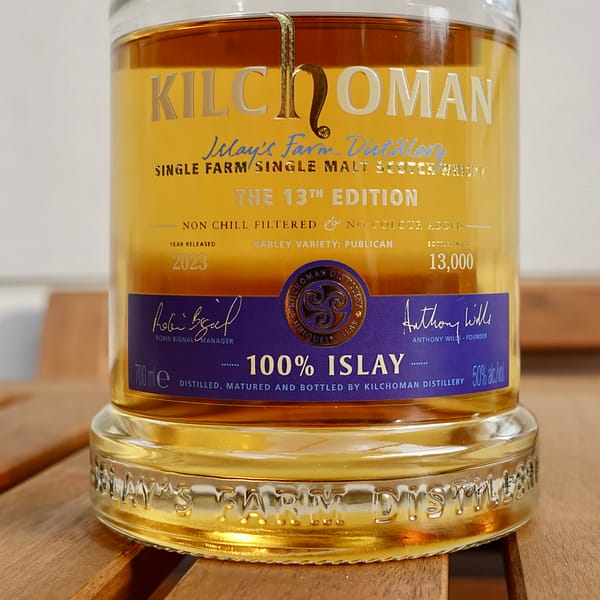
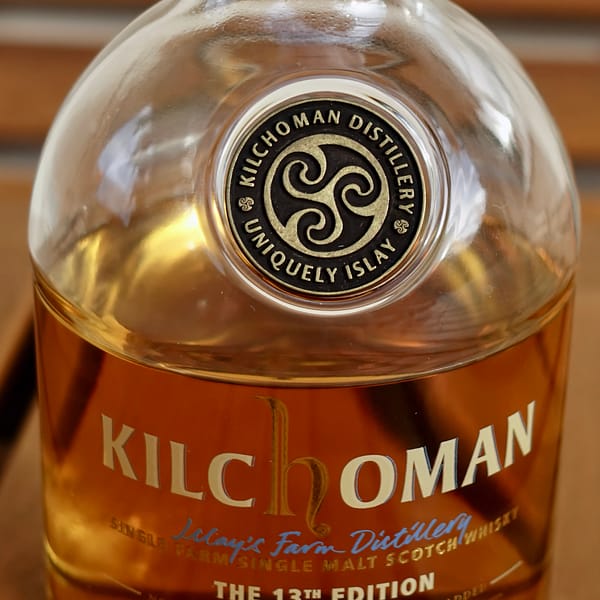
TL; DR: The cleanest sip of Kilchoman barley you can get.
Score: 8/10
Specs
Price paid: € 72
Batch: 13th Edition, 2023
ABV: 50%
Natural colour: Yes
Non-chill filtered: Yes
Casks Used: Vatting of 44 ex-Buffalo Trace bourbon barrels, mostly first fill
Tasting Notes
Colour: Pale straw, with some golden shimmer.
Nose: Intense, full of sweet, citrusy and grain-driven notes. The peat is there, noticeable but – for those used to Kilchoman’s core range – softer and significantly more floral. The first smells I recognise are barley chaff and digestive biscuits, even a touch of peanut shells. Golden syrup. Honey and lemon tea. Then the bourbon cask shows up with vanilla, cinnamon and a little ginger. Some sweet fruit: stewed pear, peaches and cherries. In the background there is a slight hint of sweet herbs, lemon verbena, even a hint of sage.
Taste & finish: The texture is quite silky and rich. The initial mouthfeel is slightly youthful – a touch hot but not uncomfortably so. The peat is there, mild, slightly more sooty now, and fully integrated in the broader palate. It adds a bit of spice and bitterness to the core of the spirit, which is grain-forward, turning now into baked goods. Well-fired rolls (the Scottish breakfast kind), golden syrup, cinnamon, pepper, dried lemon rind. Then a touch of fruit, banana and apples. The grain comes back as pure barley.
The finish is medium in length, with mild peat, petrichor, barley and a touch of fruit and citrus.
Score*: 8/10
There are whiskies that charm because of their complexity or richness. After my review, I have no doubts, the Kilchoman 100% Islay 13th edition is not that. It has some complexity for sure, but where this whisky really stands out for me is in how clean, grain-led, and powerful its aromatic expression is. The pure bourbon cask ageing certainly helps let that character shine. In achieving that, it also highlights the spirit’s elegance. It is not an attention-seeking whisky. But if you give it your time, it will impress.
* Scores are based on the scoring scale used by Dramface, slightly modified to allow half-points
Would I buy it again?
I would, or, to be honest, I already have. There is a second bottle of this 2023 release stashed away in my collection. Out of the four 100% Islay releases from Kilchoman I have had a chance to sample, this is by far my favourite. If you like a touch of Sherry in the mix, you might prefer one of the other editions, which often have some sherry cask-aged spirit in the vatting. Don’t fret. Whatever your taste, there is an edition of Kilchoman’s 100% Islay for you.
One question, pending:
Can you taste the farm?
Are the notes I found in the glass the result of Kilchoman’s own Rockside Farm barley? Or is it the production and ageing style that shines through? I would love to be able to answer that with some certainty, but it would be pure conjecture. One bottle alone cannot answer that question, because the scope of the question itself is a much wider one. One that touches a concept which whisky makers have been playing with more and more: Terroir. And something that deserves its own dedicated discussion. But that’s next week’s topic; see you then!
If you have enjoyed this content, please share a comment below and consider supporting the cost of this blog via the button below