


Just like many whisky aficionados, I am a big fan of Independent Bottlers. If you read my piece on the Independent Spirits Festival, you will know I make no mystery of that. I love their ability to provide drinkers with a more genuine and unrestrained look at what distillates can produce outside of their stymied original bottlings, when there are even some available. But today I want to look at this part of the whisky world in a different light. Whisky consumption is in decline, and Independent Bottlers might just be the saviours the market needs.
P.S. Apologies to my regular readers for the lack of posts last week. Nothing serious: I just got distracted by the final stages of the Football World Cup
Independent Bottlers will save whisky
I have heard the sentence above in some form or another a few times in the past 12 months. I have myself made that argument from a drinker’s point of view. They bring variety, integrity and personality to the output of many distilleries. But the saviour role Independent Bottlers are playing is linked to the spirits consumption decline the market is seeing.
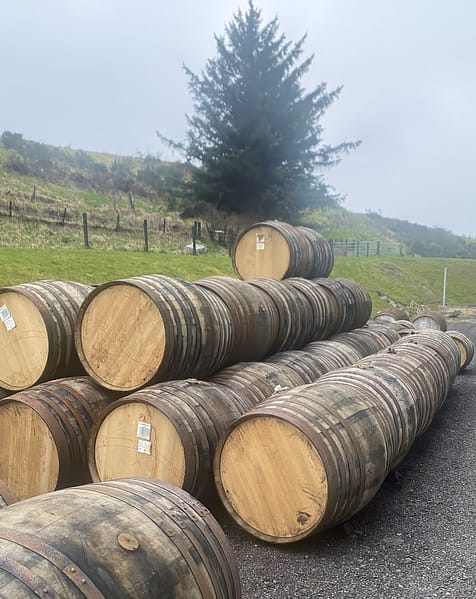
Established and new distilleries alike are sitting on unsold barrels, which are potential unrealised sales. Every barrel sitting in a warehouse unbottled is a hit on profit. And at the same time, it is also a cost. Every official release, temporarily put on hold while the distillery reassesses its output needs, translates into tens or hundreds of barrels left in stock. Each of them incurs warehousing costs, compounding the hit from the missing sales.
When the “official” industry stalls, Independent Bottlers can help ease some of the pressure on distilleries. By absorbing part of those excess casks, sales flow and warehousing costs are reduced. Effectively, Independent Bottlers play the role of a pressure valve for the industry, reducing the pressure. They become a true saviour to distillers by reducing cost and bringing in some profit in a slowing market.
Like they did during the 80s Whisky Loch.
The last Loch had somewhere to hide
The crisis which hit the whisky industry in the 1980s is often attributed to a shift of consumer taste towards white spirits, rum and vodka mainly. That shift in consumer attention definitely played a role, but so did two other major aspects. The first was the economic stagnation of the late 70s and early 80s. The other, completely self-inflicted, was the industry’s overconfidence.
Distilleries expanded production in the 70s, and new distilleries were opened to increase supply. When the crisis hit, the industry had to pivot quickly, leading to closures (some temporary, some definitive) and shifting to more uniform, standardised production methods to reduce variability, but with it, also reducing personality.
Where did the excess production land?
Some of today’s best-known and respected Independent Bottlers emerged out of the Whisky Loch of the 80s. Gordon & MacPhail, Cadenhead, Douglas Laing and Signatory thrived through one of the toughest periods in recent whisky history. They came out of the crisis with a stock of casks on which they built their success and reputation: aged casks from sought-after distilleries and lost distilleries, victims of the crisis. Casks on which these Independent Bottlers built their reputation.
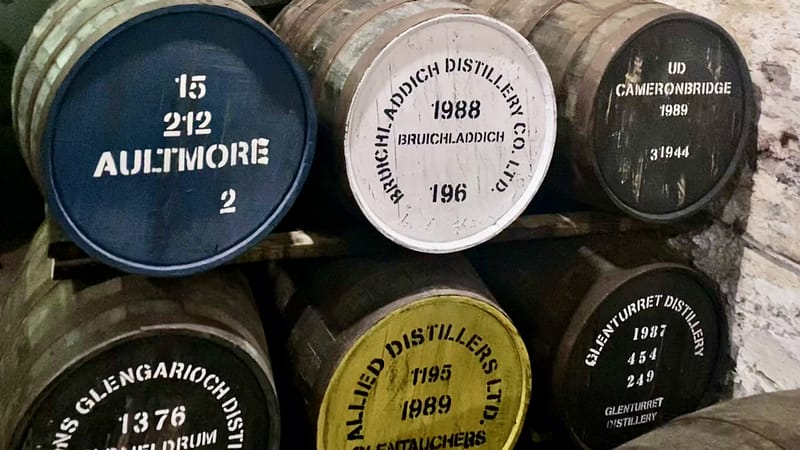
Yet, as much as I’d love to romanticise the role of IBs in overcoming the whisky loch, they played a minor role.
Most of the excess went somewhere else: into blends. Blends in a market which was still heavily focused on blends rather than single malt, and where single malt didn’t necessarily earn a price premium. A lot of that excess flowed into well-known blends, but also into “own-label” blends from shops and supermarkets. It is not surprising that many connoisseurs today look for late 80s blends at auction. They often contain high-quality, long-aged component whiskies, sometimes from distilleries that are now closed.
This one doesn’t
You could be wondering, what is different today? IBs were a footnote last time because blends did the work. The question is whether blends can do it again, and they can’t, which is what forces the bottlers to centre stage now.
The difference is in the numbers and the causes of the decline. The numbers tell the story.
If we look at the official Scotch Whisky Association’s numbers, Scotch whisky only grew 3% by volume comparing 2019 to 2023, an effective 0.74% a year. The post-pandemic slump started with a -9.5% of export value in 2023, -3.7% in 2024 and a shallower -0.6% decline in 2025, which hides a fall in volume of -4.3%.
But what is most interesting is the split between Blends and single malt once you remove the sale of bulk and other whiskies. Blends already account for 83% of the volume of whisky sold and only about 60% of the value. Single malt, in contrast, makes up the remaining 17% of volumes but close to 40% of sales.
Single Malt is also where the surplus is today. A product with a growing number of producers which, through the push of some of its bigger players, has been made progressively more premium. When your business is lacking sales and profits, burying a high-value product in cheaper blends would be a desperate, last-hope move. It worked in the 80s, when the price differential, if any, was minimal. Today, it would drive a net loss.
The supply problem hides an attention problem
To that, I need to add a second, possibly even more fundamental difference. Today’s slump in volume is linked to an overall decline in alcohol consumption in premium markets. The playground for whisky is shrinking, and the supply problem is becoming a competition for attention.
A competition that, in its most basic form, sees three players fight for whisky consumers’ attention. The large spirit conglomerates, new distilleries and, not least, Independent Bottlers. And attention in a shrinking space is a zero-sum game, in a way that warehouse space never is.
Large conglomerates, Diageo foremost but not alone, have been driving the premiumisation of single malt. Something that could be taken as justifiable if aggressive during the pandemic boom has become simply a profit strategy used to appease shareholders over consumers. They dominate for scale and marketing budgets, but, arguably, they have progressively lost touch with what the passionate single malt drinkers want: better specs, prices which are proportionate to those same specs and more transparency. Something which both new distilleries (or at least many of them) and Independent Bottlers are filling.
Both are offering the integrity, specs and transparency that aficionados want and, progressively more, at extremely competitive prices. Although not competing directly, they are both vying for the same attention and the same pool of consumers. While new distilleries are not the focus of this post, they are arguably the ones most under pressure: they have all the costs of a proper distillery (which IBs do not have), but they do not have (in most cases) the backing of a larger group able to cover a period of crisis and decrease in sales. As things stand, Independent Bottlers are, on paper, in a better place.
The glut is a boon to Independent Bottlers
The decline in sales is real, as I outlined with numbers earlier, and the results for Independent Bottlers translate into a treasure trove of available casks. We have already seen some distilleries bottled as IB from distilleries notoriously protective of their stock availability to bottlers such as Bowmore and Laphroaig, previously rare, recently released by Independent Bottlers such as the Thompson Bros. and Living Souls. And, according to some with an ear close to the market, this is only the start. Much more will come in 2027. And looking at what is happening in Scotland’s distilleries supports that prediction.
In January 2025, Brown-Forman moved Glenglassaugh to a “shared production model” with Benriach, halting distilling and making staff redundant as part of a 12% global workforce cut. Diageo paused distilling at Teaninich through June 2026 (no news of a restart as of the time of writing) and suspended its Roseisle Maltings, citing the need to “balance capacity against current demand”.
In February 2026, Suntory merged the operations teams at its two Islay distilleries, Bowmore and Laphroaig, into a single unit to “align production with long-term demand,” offering voluntary redundancy while insisting neither would close. Around them, Edrington has cut jobs at Macallan, LVMH has paused Glenmorangie, and Bairds Malt is closing its Pencaitland Maltings with 19 redundancies. Every group reached for the same reassuring vocabulary (“shared, aligned, balanced, traditional”), but the actions are anything but. It talks about the need to reduce production because the warehouses are full and the stock is not moving.
And Independent Bottlers flourish in this moment of consumption decline. They capture attention through quality bottlings of distilleries many of us were only dreaming of a few years back. And they become truly the saviours of the whisky market
It is a window, not a fortress
Yet the opportunityis transitory. It is a window of opportunity for Independent Bottlers, not a permanent, defensible market position. The ammunition Independent Bottlers use to win is fully a result of the market decline. And as such, it is extremely dependent on how the market will evolve and how much time that will take.
The most obvious change that would impact Independent Bottling is a reversal of market trends embodying the more optimistic view. If single malt sales start growing again, that cheap stock will dry up. Established and new distilleries alike would hold to their stock for their own products, and bottlers would be left with a limited and much more expensive selection of barrels, bringing back things as they stood until a few years ago.
If you are a pessimist, you might be betting your chips that the crisis will be long-lived. And that risks creating a situation where the glut of stock simply moves to Independent Bottlers, but does not shift. It gets stuck there, especially for the IBs who don’t stand out for the crowd. And if the decline continues for an extended period, it would be extremely likely. How many Independents would manage to sustain a prolonged period with limited sales?
Not everything is rosy
Today we have tens of Independent Bottlers regularly releasing bottlings, and this is likely a very superficial approximation, from large- and medium-scale ones to small boutique ones. You may be bullish on their future, but when I look at the possible evolution of the market, it is hard to avoid some degree of selection. So the question becomes, how many will survive in either scenario? Who is left standing if the cask supply stream becomes a trickle or if the customer demand stalls?
We have already started seeing how things can go wrong. Chapter 7, an Independent Bottler based in Paisley and founded in 2014, went into liquidation in late 2025, due to the cost of a new in-house bottling plant and a decline in demand. The brand didn’t die – it was absorbed by Ardent Spirits. That is, in essence, the outcome of fragility under fixed costs when demand stalls. And the ones who cannot buffer that cost get bought out by stronger Bottlers.
Who will be left standing?
While solid finances and the ability to get through a downturn, sitting on ageing stock, just like Signatory has done historically, is an insurance, I believe it boils down to customers and the value we see in the bottler’s products.
Ultimately, the bottlers who will survive are the ones who remain true to the core of what aficionados are looking for: quality and transparency at a fair price. The ones that will keep the customer’s attention by remaining true to their identity.
It is not a coincidence that this is exactly what the newer Independent Bottler favourites, like the Thompson Bros., Fragrant Drops or Little Brown Dog, offer. And in hoping that will be the case, I am also setting Independent Bottlers as the saviours of the industry. Not because of their economic role.
The economic saviour everyone’s toasting to is a short-lived role that disappears when either the glut does or if it stretches too long; the only saviour worth the name is the narrower one — the bottler who keeps whisky honest, transparent and affordable and survives because of it. The one that wins the attention game, through good and tough times.



Interesting, as I can see this glut happening, because I can now pick up excellent bottles that would have disappeared in a day a year ago. There certainly seems to be a cooling off of purchases (aside from the usual craze to snap up Springbank bottles). I have never seen so many independent bottlers at this time; there is almost too much to choose from. I contrast this with when I first got into whisky in 2008, when the SMWS were the only independent bottlers I had heard of, as it really wasn’t a big thing then. I took a long break from buying whisky because I had too many bottles, so I slowly got through them. It’s only in the last three years that I have ramped up my purchases again. Now I’m spoilt for choice with all the independent bottlers around. This is evident, as my collection has mainly increased to include many varieties from independent bottlers, as the quality and value are there. Looking forward to your future blogs. Cheers.
Thanks for sharing your experience, Mike. As someone who started seriously dipping into single malt more recently, I find it comforting to hear about your buying evolution. I have just reached that point where I know I have too much and have significantly slowed down purchases. It’s comforting to know that will pass… at some point!
In the pessimist case, what’s the next step in that progression? Simply more consolidation among IBs (or a re-absorption by any party willing to grab good stock at very low prices)? It’s a shame that we seem to be going straight from boom to bust, where we want OBs to hit our base spec requirements, to IBs delivering there, but potentially unable to weather the economic storm to stick around. Honestly, I’m not sure what direction things will take. It’s still a great time to be a consumer, but I’m not as optimistic for the longer term outcome.
Hi Miles, in the pessimistic case, I do indeed believe some consolidation among IBs will be inevitable. That would take some time, though. As things stand, I am more concerned for some of the smaller, newer distilleries that need to recoup the initial investment cost in a declining market. As for the going straight from boom to bust comment, I do think a significant share of the industry has to take a good look at itself in the mirror and recognise that they have learned little from the past: chasing short-term growth in an industry which has long-term timelines was the underlying root cause in the 80s, and it is what is behind today’s growing stock of unsold whisky.