


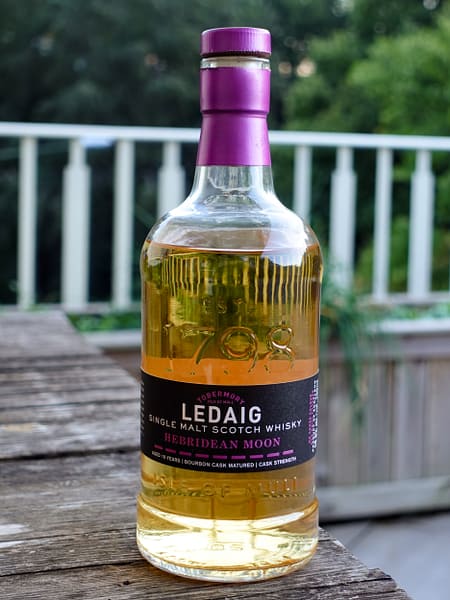
After my revisited Port Charlotte 10 review and the first instalment of the Fork in the Road series, with the Lagavulin 16, I am turning the spotlight to a new-ish bottle. Another peat forward malt. Today I will review the Ledaig Hebridean Moon, a 10-year-old special release. And with that, I am grabbing the opportunity to reflect on special editions and the stories built around them, real or constructed.
Distillery special releases have become a constant element on the whisky scene. Some are essentially regular annual releases; others are real one-off gems. Some are released to mark special milestones. Others don’t need much reason – they are there to show a special take on the distillery’s spirit different from the one drinkers can find in the official lineup.
But why is it, once you normalise for the obvious quality element, that some matter and leave a mark, while others barely register on the radar?
Special Editions: The storytellers
It all comes down to what these editions offer to the buyer. And I am picking that term over drinker intentionally, as not everyone interested in Special Editions will open those bottles.
Some special editions have a clear goal – to mark specific milestones. Inaugural releases are the obvious example, and one which has been abundant in the past few years, with the 40+ new distilleries founded since 2015 operating in Scotland.
Arguably, for some whisky fans, these are more collector items than bottles to open and drink. And some distilleries have exploited that appeal by releasing very limited numbers of bottles and pricing these accordingly. Others, like Ardnahoe, went a completely different direction: 70,000 bottles, competitively priced, made to be opened and enjoyed rather than stashed away in a collection.
I see the former as a huge missed opportunity: your inaugural release provides a unique opportunity to engage drinkers with your product and drive curiosity for future releases. One is a profit choice; the other is storytelling. Why waste the chance to build your loyal base to make a few collectors happy? Collectors who will be looking for their next bottle elsewhere?
Some distilleries used that opportunity to tell a story. Lagg partially did that with its Batches 1 to 3, showing what the distillery could produce. But arguably, nobody did that better than Ardbeg with its Young series (before the Special Edition bug went to its Marketing Department’s head). The four releases – Very Young, Still Young, Almost There and Renaissance (which I previously reviewed) – all cask strength at 6, 8, 9 and 10 years of age, allowed drinkers to follow how Ardbeg’s spirit evolved after its production restart in 1997. By showing how the whisky evolved, you could feel part of the Ardbeg team, rather than an outsider waiting for the first release. It built a real connection.
Special Editions: Give them what they want!
The other category of Special Releases that often generates interest is that which gives drinkers something they have been asking for. If you cast the net wide enough, you could include many cask-finish releases in this group. And, for some drinkers who love a specific cask type, say Sauternes or Madeira, this would definitely ring true. Yet the ones that resonate more are often those that fill a genuine gap in the distillery’s own core range: a specific age statement, a cask strength edition or an integrity bottled variant of a bottle usually chill-filtered and sold at 40% ABV.
Leave the crowd waiting long enough, and you will have a captive audience. For one of the most recent and most successful of these kinds of releases, I have to turn, again, to Ardbeg. After the release of the Renaissance in 2008, Ardbeg had not released another cask strength 10-year-old. Not until the exclusive 10-year-old cask-strength committee release for 2026. That bottle got a lot of current and past fans excited. It flew off the shelves – I considered buying one, but by the time I had decided, it was gone. The same cannot be said of all of Ardbeg’s special editions, and there might be a reason for that.
When Special Editions lose their fans
Take a peek at the shelves of your favourite online spirits retailer, and chances are you will find a few special releases from a couple of years back gathering virtual dust. Why? It all has to do with appeal.
Let’s start with a key fact: with limited exceptions, the quantity of bottles in each special release is decided on paper, often to generate manufactured scarcity. The size of that manufactured scarcity tells you how big each distillery’s marketing department believes its loyal fanbase to be. When special editions linger on the shelves, either the fanbase estimate was wrong or something in the release killed the audience’s interest.
That something more often than not falls under one of two possibilities: price or oversaturation.
Killing your fanbase through price
Diageo’s special releases are the most evident example of pricing gone wrong. Once a sought-after series by whisky fans and a collector’s item, the 2022 to 2025 releases are often still available and regularly offered at a discount. Why? Because Diageo pushed hard on its price premiumisation strategy, while the consumer had had enough.
The data shows that very clearly. I looked at the RRP for the Special Releases from 2018 to 2025, and analysed prices for the sub-21-year-old and NAS releases. I excluded the 21-year-olds and over as these are not consistently available across all years and age statements. You can clearly see the post-pandemic effect: starting from 2021, the average price went from under the £110 mark to an average of £150 in 2023. Similarly, the price spread widened, reaching peaks close to £250 (mostly due to the Mortlach NAS releases).
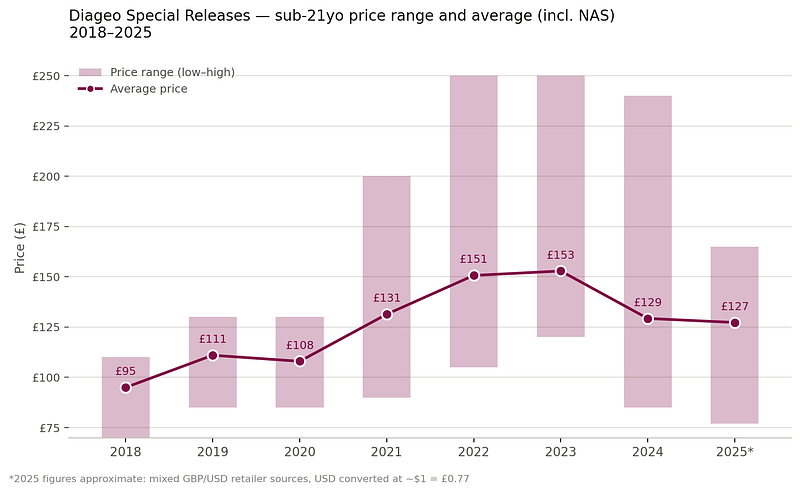
The 2024 and 2025 data show a price correction attempt. Is it working? Judging by what I see still available on several online stores, it looks like the 2025 releases have fared better than the ones from 2022 to 2024. Maybe, Diageo will take that as a signal and adjust for 2026 – one can but hope.
Killing your fanbase through oversaturation
The other deadly sin of Special Releases is oversaturation, even worse if it is combined with pricing increases. Laphroaig’s 10-year-old Cask Strength shows that incredibly well. Laphroaig fans often cite this bottling as the best entry point to taste the real essence of the distillery. And yet, the last two Batches, 16 and 17, are still available to purchase, often at greatly reduced prices: €55-60 compared to the original RRP of €80 (now reduced to €75 on Laphroaig’s own web store).
What went wrong? A mix of price increases and flooding the market with too much whisky. RRP went from around €60 in 2018 to €80 in 2023. Significant but nowhere near what Diageo did for its special releases. What is significant is what happened in 2021 at the height of the pandemic whisky craze. Rather than keeping this a yearly release, as it had been since 2009 with Batch 1, Laphroaig decided to release 3 batches (13, 14, and 15) in the space of a single year. The expected demand never materialised; bottles lingered on the shelves, and Laphroaig hasn’t released a new batch after #17 since 2023.
I haven’t forgotten about those unsold Ardbeg special releases. They fall neatly between the two: too many special releases and often too high of a price. Even those that do some things right fall into the special release trap.
Which takes me back to my initial point: what does a special release need to offer a buyer? Value. The value might be in feeling part of a new emerging distillery’s journey, or having a chance to try something usually not on the market. But even the hardest fans have a limit. The price needs to be right, and if you overdo it, releasing too much too often, the value of a special release will not be fulfilled.
Where Ledaig Hebridean Moon fits
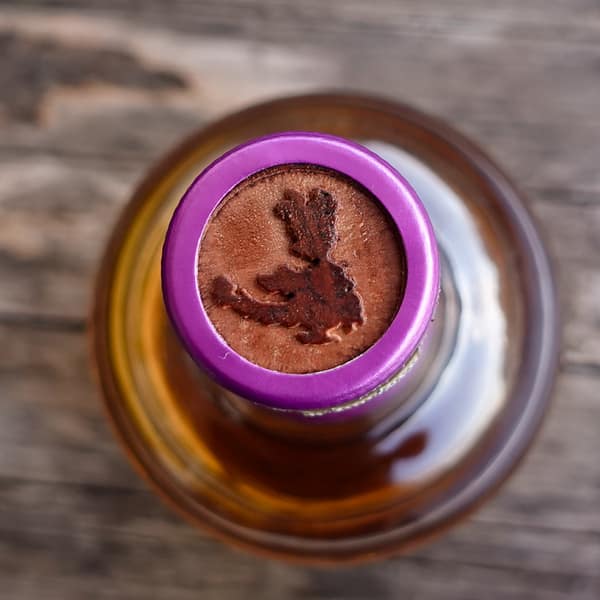
Which takes me to today’s review of the Hebridean Moon. The bottle was the first-ever Ledaig 10 Year Old released at cask strength, something that falls neatly into the category of spec-driven special release. It is also made, according to Tobermory Distillery, from the first spirit to run through its new stills and matured for over a decade in second-fill bourbon casks, a milestone in itself.
There is also an interesting stylistic choice, according to the release PR: ‘’… the Ledaig 10 Year Old is a smoulder, this is a fire. Peat-packed and salt-laced…”. As someone who has had both impressive and slightly underwhelming batches of the standard Ledaig 10, that description certainly is appealing. Nothing better than trying it out to see if the fanfare matches the spirit in the glass.
Ledaig Hebridean Moon, 10-year-old cask strength
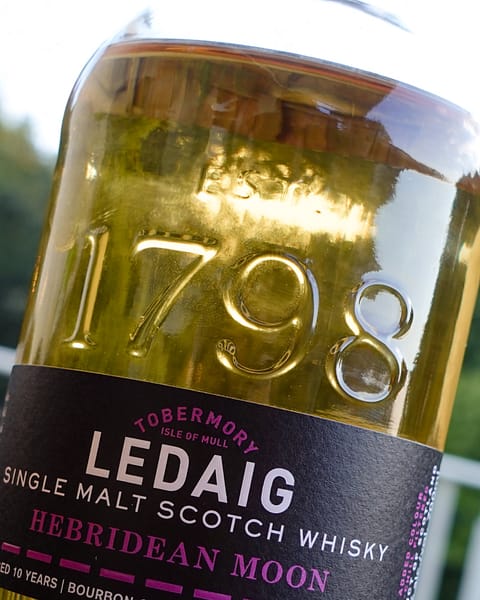
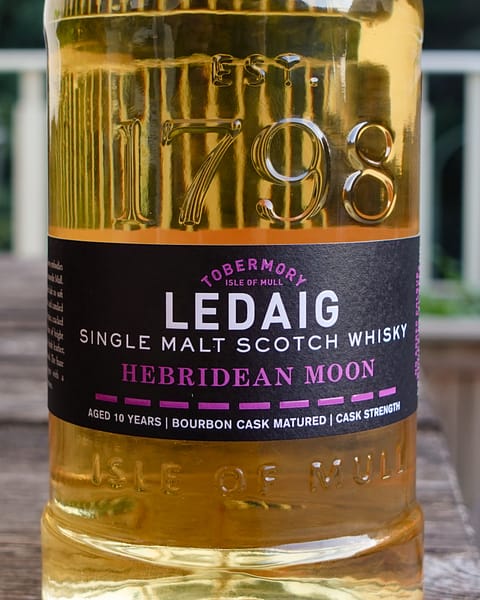
TL;DR: Delivers on the promise of a powered-up Ledaig experience
Score: 7/10
Specs
Price paid: €84.50 (RRP €105)
Batch: 24344
ABV: 58.8%
Natural colour: Yes
Non-chill filtered: Yes
Casks Used: exclusively aged in ex-Bourbon casks
Tasting Notes
Colour: Golden wheat hue, perfectly consistent with the cask ageing.
Nose: Intensely smoky, sweet and citrusy. Maritime peat with some mineral notes: iodine, driftwood fire, pebble beach. Dried and candied fruit: apples, cherries and citrus peel – lemon, orange and tangerine. Cream and a slight yoghurt note. A touch of milk tea and leather, white pepper with a sprinkling of ginger and cinnamon. A hint of peanut shells.
Taste & finish: Rich and oily, very warming. Medicinal peat. More spicy: some chilli, white pepper and a little ginger. Citrusy: lemon custard, lemon rind, dried tangerine peel. Some leather and tobacco. There are notes of malted biscuits, caramel wafers and cooked pears.
The finish is spicy: ginger and cinnamon, maritime sea spray, candied lemon, woodsmoke and tobacco. Very long. Both the taste and the nose tie nicely together in a harmonious drinking experience.
After that, where does the Ledaig Hebridean Moon 10-year-old Cask Strength land?
Score*: 7/10
Purely on taste, this Hebridean Moon delivers. While the marketing “fire vs smoulder” comparison to the standard 10 might be a bit too poetic for my taste, this does exactly what you would want a cask-strength take on a beloved classic to do. It delivers on the intensity of aromas and flavours, and it provides more depth and complexity. The only minor gripe is that Ledaig’s typical lactic note is quieter than usual. Could that be something coming from the new stills, like when Clynelish lost its waxy note after its feints receiver was cleaned? Unlikely, but not impossible.
*Scores are based on the scoring scale used by Dramface, slightly modified to allow half-points.
Would I buy it again?
Special release pricing is in itself driven by its scarcity, so, as a single one-off edition, the price I paid, €85, is on the high end but something I’m OK with for a one-off. Yet, truth be told, I would love for Ledaig to release a Cask Strength version of their 10-year-old as a more regular release (every one or two years). Would I buy it at €85? Probably not – something closer to €70 would be a fair price.
Where does Hebridean Moon land as a Special Edition?
Considering the benchmarks I outlined for Special Releases, is the Ledaig Hebridean Moon a successful special release? Mostly yes. It provides Ledaig fans with something that many were keen to try: a cask strength version of the 10-year-old. Price-wise, as a one-off, it is on the high end of what I would consider fair, but less so than other Ledaig special releases like the NAS Three Wood or the 9-year-old Bordeaux cask matured.
Where it does fall is in representing a milestone. The new stills connection is not something that anyone except the most die-hard Tobermory fan would be aware of. And it is also not something exceptional. Every distillery eventually replaces its stills at regular intervals; every 25 years is a commonly reported timeline. If Tobermory really wanted us to understand the impact of such a change, maybe it should have released two sister bottles, one before and one after. I cannot help but feel that in this case, the milestone timeline is mostly a marketing gimmick.
What is surprising to me is the continued availability of the Ledaig Hebridean Moon on the market. A sign of declining whisky sales overall or a consumer verdict? This is the one loose thread in an otherwise clean case. In doubt, I’ll continue enjoying my bottle. Slàinte!
After writing my tasting notes, I always find it interesting to look at other opinions. Here are a few other reviews of the Ledaig Hebridean Moon I enjoyed: