


Today’s whisky review looks at Zuidam’s Millstone Tulip Collection No.4, a heavily peated, cask-strength Dutch single malt, matured in a first-fill PX butt and bottled at 54.8% exclusively for the German market. I paid under €45 and landed on a 7/10 score: a nose I loved, a palate that didn’t quite follow. And it continues the peat-beyond-Islay thread after my revisited Longrow review and last week’s Cù Bòcan 15. It is also a great bottle to see if a non-Scottish malt needs to follow the Scottish style, or if it can make its own mark.
Millstone Dutch Tulip Collection 2018 Heavily Peated at a glance
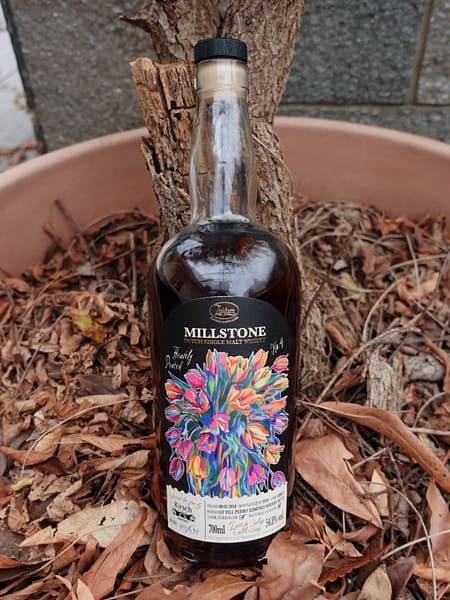
| Score | 7/10 |
| TL;DR | An usnusually earthy, tobacco-laden take on peat plus Sherry |
| Price paid | €44.90 |
| Release | No.4 |
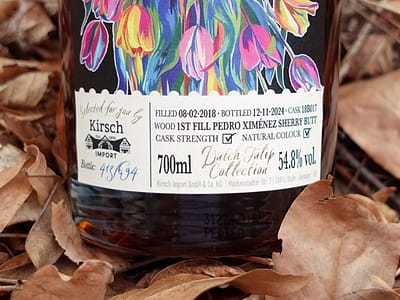
| Cask no. | 18B017, filled 8/2/2018, bottled 12/11/2024 |
| ABV | 54.8% |
| Natural colour | Yes |
| Non-chill filtered | Yes |
| Casks Used | 1st fill PX Sherry Butt |
European whisky: Imitation or Identity
The whisky business might be in a bit of a slump (or even a full-blown recession according to this article), and yet the European whisky scene continues to evolve and grow. France and Germany still take the lion’s share outside the British Isles, but a multitude of countries can claim their own whisky distillery, even tiny Cyprus. Based on the latest 2027 Malt Whisky Yearbook, the number of European whisky distilleries is approaching 300 units.
It raises a question. Should distilleries outside of the traditional producing regions try to mimic the tradition of Scotland and Ireland, or should they try to make their own mark, with their own recognisable style? In this case, it is not a matter of terroir. Rather, unlike Kilchoman’s 100% Islay, it is a matter of finding a style of its own. The Millstone Dutch Tulip Edition No.4 I will review in a moment, certainly is an interesting one to put under the microscope with that question in mind.
A peek at Zuidam Distillery
Zuidam does not come with a long-standing whisky heritage attached, and I rather like that. This family distillery was founded in 1975 (or 1976, depending on the sources) by Fred van Zuidam in Baarle-Nassau, a town famous for sharing one of the most complex international border systems in the world with the Belgian Baarle-Hertog. It built its name on liqueurs and genever, the Dutch juniper spirit that came long before gin. Whisky arrived later.
Patrick van Zuidam, who now runs the business with his brother Gilbert, began experimenting in 1996, and the first Millstone single malt was released in 2007. The name nods to the traditional milling of the barley, a gentle process that keeps the grain cool and, the distillery argues, preserves its aromas. Fermentation is slow, around a week, and the spirit runs through small copper pot stills with a generous copper surface for their size. Bottlings are non-chill filtered and uncoloured. The casks often do much of the talking: plenty of first-fill wood is used, especially for the special editions.
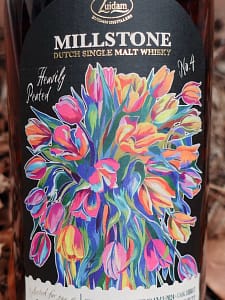
The Tulip Collection is a series of heavily peated single casks selected for the German market through Kirsch Import, set alongside the unpeated Windmills series. This is edition 4, matured in a first-fill Pedro Ximénez cask. It is essentially sold out, but follow-up editions (we are up to number 7) are available on the German market.
A distillery that learned its craft on genever and liqueurs, rather than on Scotland’s template, is a good place to ask what a peated malt looks like when nobody is trying to copy Islay.
Why did I pick this?
I bought this bottle after trying the previous edition no.3, aged in Moscatel casks, as part of a Whisky Advent Calendar organised by a friend. I was intrigued by how different it was. Positively. Among the group of whisky mates sharing that calendar, others were more shocked than intrigued, and some downright hated it. Edition 3 was sold out by the time I went looking for it, but I found the Millstone Tulip Collection No.4 I picked for today’s review. I wanted to spend more time with the whisky and understand if a European whisky can stand up to Scotland (and Islay). And I also wanted to see if the style was trying to imitate the Scottish style or carve its own path. Time to see…
Review
Colour: A nice rich warm amber, not as dark as I might have expected from a first fill PX cask.
Nose: The peat is there but is perfectly integrated with the cask notes. Rich earthy notes emerge first: old leather, damp earth and a lot of aromatic pipe tobacco. Damp charred wood. Then red and dark fruits: brambles, plums, cranberries. A noticeable herbal accent adds freshness: spearmint and celery leaves.
Adding water brings out the peat more, becoming a touch more medicinal. The fruits become more prominent and the earthy notes fade in the background.
Taste & finish: The mouthfeel is warming, slightly thinner than I expected for the ABV. At the same time, the alcohol shows no sharpness. It tastes sweeter than the nose suggested. Molasses, plum, dark chocolate. Again, a lot of tobacco, more cigar than pipe now. A little chilli pepper. Some peat is noticeable, slightly medicinal and smoky, but it hides in the background. The finish is relatively short, with notes reminiscent of the palate.
With water, the texture improves somewhat, but the sweetness becomes quite dominant. Overall, it loses definition and contrast.
Score*: 7/10
Before I get into the reason behind the score I picked for my review of the Millstone Dutch Tulip Collection No.4, let me answer the question which opened this post. Does a non-Scottish malt need to follow the Scottish style, or can it make its own mark? Zuidam treads the balance carefully. This is very much something recognisable as a single malt whisky, something not always so obvious for me with European whiskies, especially those employing column stills.
The combination of spirit production choices, cask and likely ageing conditions manages to give it its own unique character. The rich, earthy, fruity and herbal nose is something that sets it apart from its Scottish counterparts. As does the peat, a background note in a nominally heavily peated whisky. Ardbeg Uigeadail is the counterpart that comes to mind for me, and the difference is not subtle between the two styles. In this bottle, the cask seems to amplify the spirit rather than overwhelm it, while the Ardbeg is mostly peat-led.
Now to the score. I loved the nose on this one. Full of personality, rich, complex. And in a way, it is also why the score is not higher. The palate is good, but not as the nose. And as often the case, expectations can be unforgiving – the nose promises something luscious on the palate, and the spirit I tasted simply didn’t live up to that promise, even if it is pleasant. It is still a very good whisky, offered at a fantastic price.
* Scores are based on the scoring scale used by Dramface, slightly modified to allow half-points
Would I buy it again?
Writing a review for a special edition whisky like this Millstone Dutch Tulip No.4 always comes with a risk. Once it is gone, that’s it. The limited number of bottles often means that the chances of buying a second one after a couple of years become slim to none. But it opens the door for its successors. I am definitely looking forward to trying the last editions still available from online retailers. And, at a sub-€50 price, the value is great.
If you got to this point, thanks for staying with me until the end of this Millstone Dutch Tulip Collection No.4. I really appreciate it. Next week I will take a break to fly to Scotland for this year’s Glasgow Whisky Festival, and maybe some reporting on that will follow when I am back on November 15th. Till next time, Slàinte!


