


After my last review of the Kilchoman 100% Islay I was left thinking of a word. A word whisky producers reach for when they want a bottle to connect to a place. Terroir. It sits on some back labels, in several press releases. Many of us wonder if whisky has terroir or if it is just another marketing gimmick. But almost nobody stops to ask what that word is meant to mean.
Whiskies like the Kilchoman 100% Islay are, on paper, the closest thing Scotch has to terroir. Barley grown on the farm. Malted on the farm. Distilled, matured and bottled on the farm. A whisky with a sense of place.
If any whisky can claim to taste of somewhere, this checks all the boxes.
And yet, when I started to write why that was the case, I started digging into the word itself. And I ended up opening a can of worms.
That is why this post did not go up last week. I had one conclusion, a different one, then a third. But they all fell flat once I tested them against the actual definition of terroir. Or rather, definitions, I should say.
The fight over a word’s definition
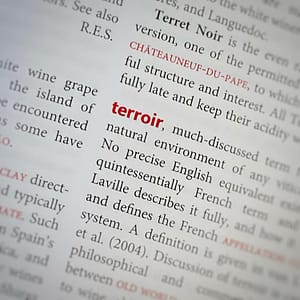
Terroir is a wine term, and wine researchers have been arguing about its perimeter for decades. The argument matters for whisky because it decides the answer. (Unlike other articles, you will find several links to references today, as I will be quoting others’ opinions to support the argument, while being clear when a position is derived from my reasoning and opinion. )
On one side sits the natural-only reading. Laville, writing in the Bulletin de l’OIV in 1993, separated the “natural terroir unit”, a stable combination of topography, climate, substrate and soil, from terroir proper. He argued that human practice and plant material do not belong in the definition, because both keep changing as growers experiment, while a terroir should change very slowly if at all.
On the other side, Morlat, in his book Terroirs viticoles: Étude et valorisation (2001) describes viticultural terroir as two groups of factors. The natural ones (climate, soil, geology) and human ones, meaning viticultural and oenological practice.
This short article by Carey and Bonnardot in IVES summarises the debate. They point out that how much weight each group deserves is the main source of argument. And that consensus on the definition has yet to be reached.
What the definitions share matters more. Almost all of them need a stable set of natural factors that can be mapped, a potential to produce something distinctive, and a difference that people can recognise over time. Place, stability, recognition.
To be fair to whisky, I will test the concept of whisky terroir twice. Once the strict way, with natural factors only, and once the generous way, with people included.
The strict reading: grape vs barley
In wine, the natural case is easy (or perhaps easier) to state. A vine is a perennial plant that spends decades growing and producing fruit in one location. In one soil.
The soil’s capacity to hold and release water is among the most important variables shaping the berry. The IVES paper calls rooting depth and water-holding capacity a dominant terroir factor. The berry is then the flavour-carrying material: its aroma precursors, acids, and sugars reach the cellar already shaped by that place. Maceration of crushed grapes, a key step for wine’s aromatic enrichment, adds the rest.
Barley is a different animal. It is an annual, rain-fed crop. The plant grows once and is then cut and threshed. What a distillery mostly wants from it is fermentable starch. The flavour is made later. Argument closed – the impact of strict terroir on whisky is at best negligible. Or that is what I thought.
I expected to end the argument there. Clean and efficient. But as often happens when you do scientific literature research, you inevitably end up on something that challenges your view.
I then found this paper by Kyraleou and colleagues, from a team spanning Teagasc, Oregon State, and staff from Waterford Distillery, funded through an Enterprise Ireland grant in collaboration with Waterford. The connection with Waterford is worth highlighting. Not to cast doubt on the work of the team who carried out the study, but to transparently recognise that the study is not fully independent and some bias, even if subconscious, may exist.
The case for barley terroir
The group grew two barley varieties at two sites in Ireland over two seasons. They malted and distilled everything the same way at lab scale, and had the new make assessed by a trained sensory panel. Variety, growing environment and the interaction between them all shifted the character of the spirit, and environment mattered more than variety alone. The two sites differed in soil (one alkaline and limestone-based, the other acidic to neutral) and in weather (one inland, warmer and drier; the other more coastal and wetter), and the spirit followed: the inland, limestone site drank as more pungent, earthy and malty, the coastal one as more floral and fruity.
The authors call it a terroir effect. For new make, at those two sites, I think that is a fair reading. The qualification is the point. The authors say themselves that the study stops at new make, and that whether the effect holds after maturation remains to be determined. And, with a few exceptions, new make is not what whisky drinkers consume.
Personally, I feel the statistical difference between two sites is a starting point for terroir. But it is not the same thing as a place fingerprint a drinker can recognise. Yet, the paper does at least leave the door open for whisky to have terroir. But it is a first gate pass only. The final one is at least three years away (in Scotland and Ireland).
Even if barley has a terroir signature, it still has to get through the rest of the process that makes it whisky, and the rest of the process is anything but neutral.
Where the flavour is actually made
Fermentation alone is a major source of what ends up in the new make. Yeast turns sugar into alcohol and, on the way, produces esters and higher alcohols, the fruity, floral notes that make the aromatic backbone of the spirit. A 2024 review in FEMS Yeast Research calls the choice of yeast strain one of the most important factors in the character of new make and young whisky. A study of 24 commercial strains confirmed that yeast contributes alcoholic, fruity, sulfury and sweet notes, although individual strains turned out harder to tell apart than I would have expected.
The Kyraleou study, even when it highlights the terroir effect on new make character, does not contradict that argument; it points, at least partially, the same way. Of the six most impactful aroma compounds it found, four were not shifted by variety, environment or season, including isoamyl alcohol and ethyl hexanoate, both formed mainly during fermentation. Two did change with the site. It is not a clean split, and the exceptions matter.
The two compounds that changed with the site, (E)-2-nonenal (fried, toasted, fatty) and β-damascenone (honey, tea, plum), were not minor aromatic players. They ranked first and second in the paper’s flavour dilution ranking, and by some margin. So the barley’s environment may be moving some of the most potent odorants in the new make, which is why the finding deserves to be taken seriously. It is also where the cask enters and potentially flattens those effects. The authors note that (E)-2-nonenal is also released from wood during maturation, and that β-damascenone is a key aroma compound in aged bourbon (and therefore potentially found in ex-Bourbon casks). Whether a site signal in these compounds would survive, or be buried, in a mature whisky is the question the study leaves open.
The “natural” virdict on whisky terroir
The point against whisky terroir, in its stricter definition, comes down to who makes those choices. Yeast strain, fermentation time, temperature, the cut points on the still: all of them are decisions taken by the distillery, not by the field.
Then comes the cask. Possibly the last stake through the strict definition of whisky terroir. The common adage you will hear from distillery staff again and again is that the cask makes up anything from 60 to 80% of flavour. That is trade lore, coming from experience and not hard data, but it explains why a barley signal might be so hard to find in a mature whisky.
Terroir, in its strictest, purely natural sense, is something that, even generously, is diluted and masked by cask ageing. And therefore, not something verifiable.
The generous reading
If whisky fails the strict terroir definition, what about the generous one? Take Morlat’s human factors seriously and ask what they would mean for whisky.
In wine, a producer can at least try to get out of the way. Non-interventionist winemaking and ageing in neutral steel or concrete, neutral containers which let the wine age without imparting additional flavours, are attempts to let the place speak, and whether or not they succeed, they make the human contribution something you can reason about. Scotch and Irish whisky have no such option. Distillation is not optional, and neither is wood cask ageing: Scotch must spend at least three years in oak casks. Every decision in that process – the barley malting, the yeast, the still shape, the cut points, the cask – is a human one, and every one of them is also part of the house style.
Terroir or house style?
That is the problem. Once human practice is inside the definition, terroir and house style collapse into a single output, and nothing in the bottle lets you separate them. I can taste a distillery’s style. But I cannot taste where the style ends and the field begins. Laville excluded human practice because it evolves. I am tempted to exclude it for a simpler reason: it cannot be separated from the style it produces.
Peat adds more complexity and is an obvious objection, one I have deliberately left out of this analysis. Locally cut peat adds a level of place, which some could argue is as much a part of terroir as the barley is. But the decision to peat, and how much, is a human one, and it is a major aromatic effect that can mask everything else. Kilchoman’s milder 20 ppm peating level (vs other Islay peers) in the 100% Islay reduces that effect, but it is still a producer’s choice.
Yet, the conjunction of natural and human elements is also where I see a terroir definition which is whisky’s own. One where a distillery’s whole chain, from barley through fermentation and distillation to ageing, is tied to an identifiable place. And one run with a defined method that holds over time, so that it becomes a constant rather than another variable. Linked to a place, not necessarily owned by the producer. Local barley rather than farm-grown barley. But one which represents one identifiable site.
And the best evidence that this is possible, and of how it comes about, comes from Cognac.
A lot of the points I raised against whisky terroir apply to other spirits. And yet there lies the potential objection to my argument. Cognac is the obvious one, and a good one. It is distilled, it is aged in oak, and terroir is very much part of its identity and how it presents itself to the world.
What Cognac gets right
Its terroirs directly link to delimited vine-growing areas, not to distillery locations. And it can be argued that the grape does leave something in the glass: distillation releases terpenes and norisoprenoids from precursors in the base wine. But a 2024 study of Cognac aroma notes that the majority of its aromatic contribution comes from yeast activity, distillation chemistry and wood ageing, and the compounds it ranks as most influential are mostly esters, alcohols and acids of the kind yeast produces. That is not very different from what I have argued for whisky.
So why does Cognac have terroir while Scotch is still arguing about it? I think the answer is mostly social, but it starts from something natural. The cru structure was built over time. In 1860, the geologist Henri Coquand described the variations in soil and climate across the region, and the six crus follow them: as a rule, the finest sit at the centre, on the most chalk, and the outer ones have more clay or sand. In Laville’s terms, this is a map of natural terroir units. Those sub-regions were ratified by law in 1938, and after that, for decades, producers have been working within and defending that map. The Difford’s Guide has a good summary of it all.
The soil basis was real enough to start from. In that regard, the wine-centric terroir concept was certainly helpful. What made it terroir was that the whole category agreed to treat it as meaningful, kept the method stable, and kept saying so. This is also why the cru hierarchy still shapes Cognac’s pricing and perceived quality, with Grande and Petite Champagne at the top. Terroir here is partly a construct, but a stable, shared one tied to a place. That is the part whisky has not yet managed to build.
Waterford and the problem of proving it alone
Waterford was the loudest champion of whisky terroir, and, in one respect, it was the most honest. Single-farm releases with the origin of the barley on the label are a serious attempt to test the idea in public, and I respect the willingness to put it on a shelf. IIt remains to be seen if that will continue after its acquisition in March 2026 by the Tennessee Distilling Group.
My problem was with the method. Terroir is not something one producer can establish by itself, through a series of examples. It is a recognisable outcome: the drinker has to be able to tell one place from the next one. In wine, and Cognac, that recognition is built by many producers, each championing their own ground over generations.
Waterford released many farm whiskies. Too many, I would argue. The most common critique I heard in the past years about Waterford from fellow drinkers? No one understood what their style was. Too much variety, all released too quickly, and all promoted by a single distillery. The end result: confusion rather than recognition.
Terroir as a concept is not a given. Even in wine, it has its fair share of doubters. In whisky, many of the arguments I outlined could easily be taken to argue that the concept of terroir should not apply. And yet I still think it has a place. But it needs to be built. In time and by multiple producers. Claiming it before the recognition exists is how the concept of whisky terroir dies before it has had time to develop.
Back to the bottle
Which brings me back to the Kilchoman. If any whisky could make the case, it is this one. Yet is it really terroir? Is that Islay, or is that the terroir from Kilchoman’s Rockside Farm? Today I cannot separate the house style from the terroir, and neither can anyone else, because the process that makes the whisky is also the style that defines it. But maybe it is the start of a defined terroir. A bud, but not the full plant.
Whisky terroir is not impossible, but it is not what the marketing messages promise. The natural case is thin, and the human case collapses into house style unless a method holds over time. Cognac suggests the missing piece is the social element. To become a real living concept, whisky terroir would need three things: a place genuinely linked to the whole chain, from barley to maturation; a method that holds over time; and, above all, a body of producers who establish styles drinkers can recognise, with enough examples to allow comparison. Terroir may begin as a physical effect, but it becomes real through producers collaborating towards it as a shared goal.
Kilchoman meets the first and is building its way to the second with years of consistent releases. But the third needs more than one producer. And the ranks are, slowly, growing. Some like Springbank and Bruichladdich have been championing local barley for some time, if not strictly terroir. Newer farmhouse distilleries, with their field-to-bottle ethos, could build up critical mass. Time will tell.
I started this piece believing that terroir was about place. And I still do. I just no longer think that is the whole story.