In the introduction to David Stirk’s Independent Scotch, Serge Valentin of WhiskyFun fame, recalls the first time he came across Independently Bottled Whisky, describing it as “unknown distilleries, all packaged the same”. (Spoiler: It won’t be the last time you hear about this book in this series). For whisky drinkers used to Distilleries’ own branded labels, IB labels can be confusing. They are lacking the usual references that catch our attention. But in reality, these “all the same” labels are a treasure trove of information. You need to know what to look for. So I wanted to share a quick guide on how to read an Independent Bottler label for all those who are new to IBs.
This post is part of my series on Independent Bottlers. Sundays for the IBs 101 posts and Wednesdays for the reviews focused on IBs
What information can you get from an IB’s Label?
Independent Bottler’s labels may seem intimidating at first. Often, they look identical at a glance, though not always, with the only difference being in the details. This can be not only daunting but also confusing. However, once you understand their structure, they reveal a level of detail often missing from official distillery bottlings. There are five key details you will find on an Independent Bottler’s label. I will focus on each of these first and then show a few examples. This will help you get started on how to read an Independent Bottler’s label.
The five key pieces of information on an IB label
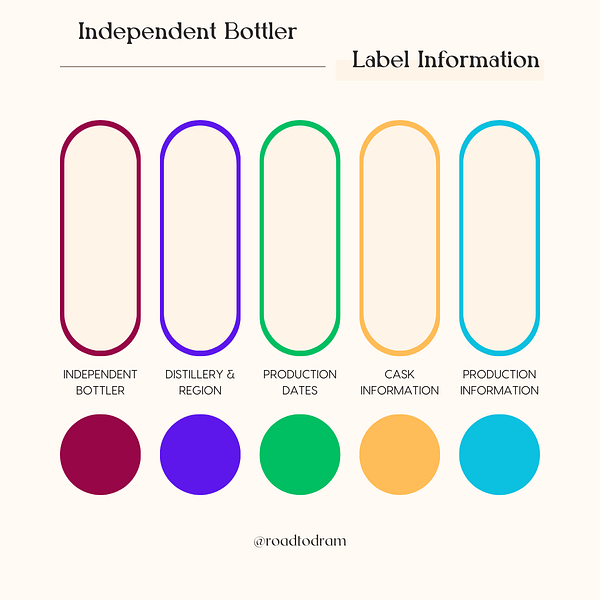
The Bottler
The first detail you will find, often prominently, is the Independent Bottler’s name or, in some cases, a specific brand they use. The bottler is telling us, as consumers, to trust that they selected a great cask or batch of whisky for us. This can be the most daunting choice at first. If you are new to IBs, who should you trust? Experience, reputation and word of mouth (in person and digital) help. Following the reviews that accompany this series will help to begin – I am picking just a few well-known and trusted IBs. You can take these as a start, and further down the series, there will be a more comprehensive list.
The Distillery (and Region)
Next is usually the distillery’s name. It is worth noting that occasionally, IBs are not allowed to name it explicitly. In both cases, the names may be unfamiliar. Many IBs bottle spirit from distilleries which have very limited releases, so their names might be unfamiliar. In other cases, the IB is explicitly prohibited from declaring the distillery name when acquiring the spirit. In those cases you will see something like “A Highland/Islay/etc Distillery”, declaring only the region, or a fantasy name, sometimes linked to the history or location of a distillery, like Williamson or Kildalton or, at times, humorous, such as Glen Litigious.
I will dedicate next week’s IB 101 post to these fantasy names, so more to come, but what to do when you are unsure if a distillery name is real or made up. Usually, the labelling will hint at the fact that the real distillery cannot be named, so you can guess that the name is a fantasy one. And if you want to be sure, The Scotch Whisky Association has a pretty regularly updated page which lists all the names which you can use to check if a certain name represents a real distillery.
Age Statement & Maturation
Age statement and vintage will tell you when the whisky was distilled and how long it matured. The age statement, or how many years old your whisky is, is the minimum you will find. Many IBs will also state both when the whisky was distilled and bottled. While this may seem superfluous, it can be important to distinguish between potentially similar releases from the same bottler.
You will often, if not always, also find a description of the cask used to age or finish the whisky. If the label states that a whisky was aged in a certain barrel type, like Bourbon, Sherry or Port, then the whisky was fully aged in the cask. If the whisky was finished in a specific cask type, then it likely spent the initial part of its life in refill casks (mostly ex-Bourbon) and only finished for months to years in the cask indicated. Some IBs will also state the length of this finish stage, but not all will.
Occasionally, IBs will have to be vague about the cask. I recently had a chance to taste an IB whisky aged in second-fill Sherry. Usually this would be Oloroso Sherry, but in this case the Bottler themselves admitted they couldn’t be sure. The aromatic profile hinted at something different, maybe Fino or Palo Cortado Sherry. More often than not, when this happens, it is because the documentation about the cask they acquired to bottle is only partial.
Other production information
The last, and most variable part of the information on the label, relates to production information. The outrun size, or number of bottles produced, is often provided. This can indicate the rarity of a bottling, but also reflects the size of the cask used. A Sherry butt (500L) could yield close to 600 bottles. A hogshead cask, probably the most common one used for Single Malt, can yield around 300 bottles. Age plays a role: the older the whisky, the higher the evaporation and the lower the yield. Anything over 5-600 bottles is going to be a vatting of different casks.
The ABV will always be displayed, it has to by law. If the whisky was bottled without dilution, the label may state it is cask strength, but that is not always the case. Some IBs only bottle at Cask Strength and take it as a given. Others prefer to dilute the spirit, albeit in a very limited way, to bring it to an ABV they feel allows for the whisky to express its character at its best.
The other information most IBs will clearly state on the bottle is the fact that the whisky is non-chill filtered and that it has natural colour. This is often a point of pride for IBs, who make it a point of principle and pride not to mess about with the spirit and instead allow it to express its pure character.
Now that you have the tools to understand how to read an Independent Bottler’s label, it is time for…
A few examples of IB Labels
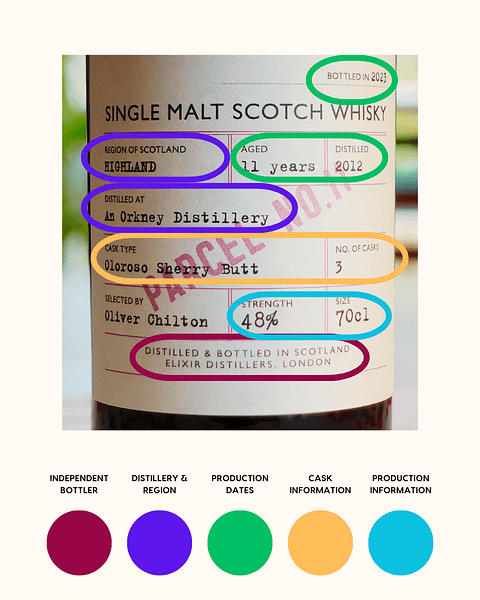
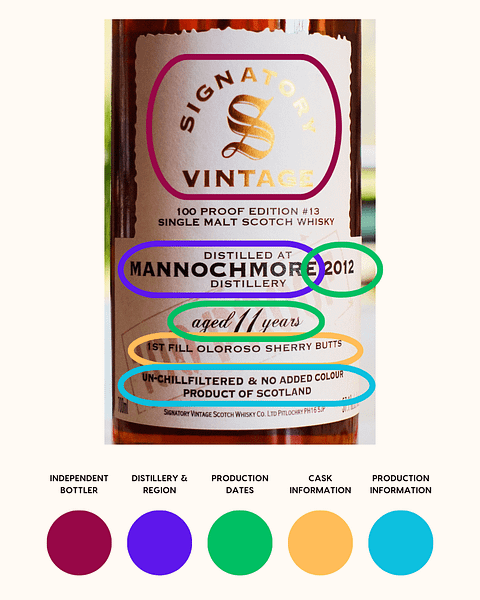
The two labels below are examples of Independent Bottler labels where the information is mostly shown on the front label. This is probably the most common format you will come face-to-face with.
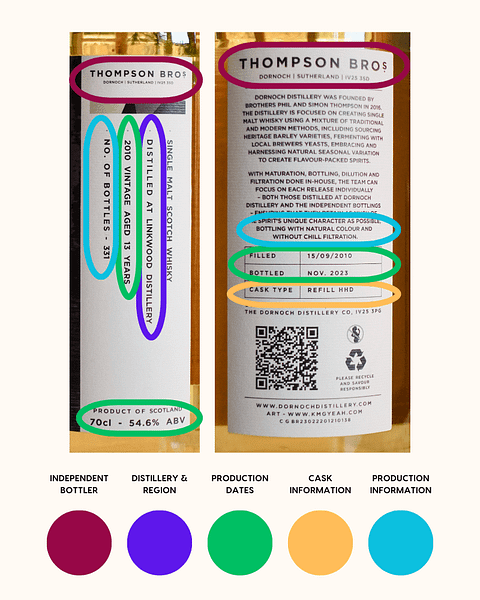
Occasionally, the information will be split between the front label and the back, like in this Linkwood by the Thompson Brothers, which I will review in a couple of days.
I hope the explanation of the five pieces of information on the label, plus these three examples, will help all those dipping their toes in the fantastical world of IBs understand how to read an Independent Bottler’s label.
See you next week when I will discuss those secret distillery names IBs use.
Independent bottlers 101 series Index
What is an Independent Bottler?
How to Read an Independent Bottler’s Label (This Post)
This week’s IB review
Single Malts of Scotland An Orkney Distillery 2012 Parcel 11
Thompson Brothers Linkwood 2010
Interested in my take on a specific whisky style? Check the full Journey here and jump to the relevant Chapter.
If you have enjoyed this content, please share a comment below and consider supporting the cost of this blog via the button below