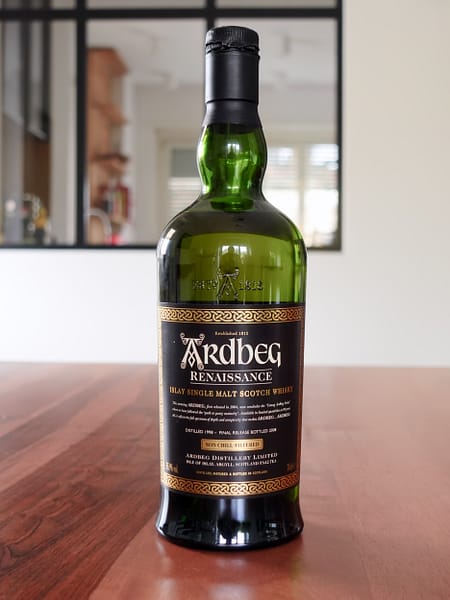
I am writing this review while on my way to the 2025 Glasgow Whisky Festival, an event that has a special place in my heart. The atmosphere, exhibitors, the people attending (many of them whom I consider friends) and the fantastic organisation make it a great event in itself. The fact that it takes place in Glasgow, a city I called home for over a decade, makes it even more special on a personal level. I felt that this week’s review deserved a special bottle, so I chose Ardbeg Renaissance, the first 10-year-old release made entirely after the distillery reopened in 1998.
While reviews of older bottles are not something that will appear frequently on Road to Dram, I do plan to revisit this topic to mark some special occasions. More often than not, these older bottles will come from auctions. In this case, instead, this bottle is one I bought on release, back in 2008, and then I feared lost for a while. Having moved four times in 15 years, this Ardbeg had landed in one of too many moving boxes that hadn’t been opened since the first house move. I was ecstatic when, clearing the attic to make some space, I finally found the box again – even if it was mislabeled by yours truly as a box of old DVDs. There are two lessons here. First, never lose track of how. But second, and more important, label your moving boxes correctly!
TL:DR: A one-two whisky: Lures you into a comforting space with its aromas, then delivers a punchy Ardbeg character on the palate
Score: 8/10, Something Special
The road to Ardbeg’s 1998 rebirth
If you are an Ardbeg fan, feel free to skip to the review
Ardbeg distillery’s history goes back to the early 19th century, though the style we know today started once the then mothballed distillery went back into production in 1998. 1815 is the official founding date, though rumours suggest illicit distilling was already happening a few years earlier. The distillery continued through operate, going through several ownership changes, until the great depression.
The distillery reopened after the great depression and was acquired by DCL (now Diageo) and Horam Walker in 1959. Through the 60s and 70s, demand for its spirit in blends increased. Due to this, in 1974, the distillery stopped producing its own peated malt and switched to Port Ellen’s malt instead. Hiram Walker took over full ownership in 1979, but the infamous whisky loch of the 80s hit Ardbeg hard. It was mothballed in 1981. In 1989, production restarted, but only for a couple of months each year.
While the distillery suffered, the spirit from Ardbeg had been steadily gaining a following. In 1997, Glenmorangie decided to acquire Ardbeg and its existing stock and revamp production. In order to showcase the distillate produced under the new ownership, the Young series was released to a market keen to follow the evolution of the distillery.
The Ardbeg Young Series
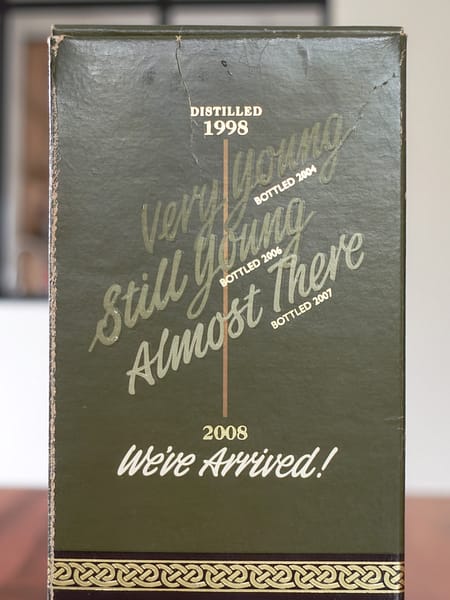
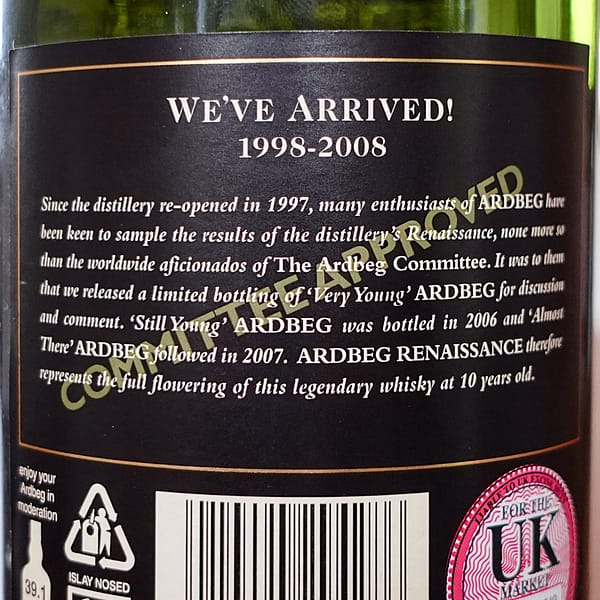
The Young series was made up of four cask strength whiskies, all coming from stock originally distilled in 1998, the year when the distillery restarted operations. The first release, in 2004, was the Very Young, released in 2004 at about 6 years of age. This was followed by the Still Young in 2006 and the Almost There in 2007.
The final release in this series from Ardbeg, the Renaissance I am about to review, was released in 2008 as the final instalment under the motto “We have arrived” to mark the distillery’s new product finally turning 10.
I find the naming of the series betrays a concern for releasing young spirit and a desire to manage expectations. Looking at it with today’s eyes, and the multitude of young releases we are seeing from new distilleries started after the year 2000, feels slightly ironic. Even more so if we consider the multitude of NAS releases Ardbeg has put on the market since then.
But leaving my cynicism aside for a moment, it is clear that the 10-year-old mark was important to Ardbeg. The fact that the standard 10-year-old remains one of the distillery’s key expressions is a testament to that… and rumours point to a 10-year-old cask strength hitting the market in the near future. I’l keep my fingers crossed.
Ardbeg Renaissance
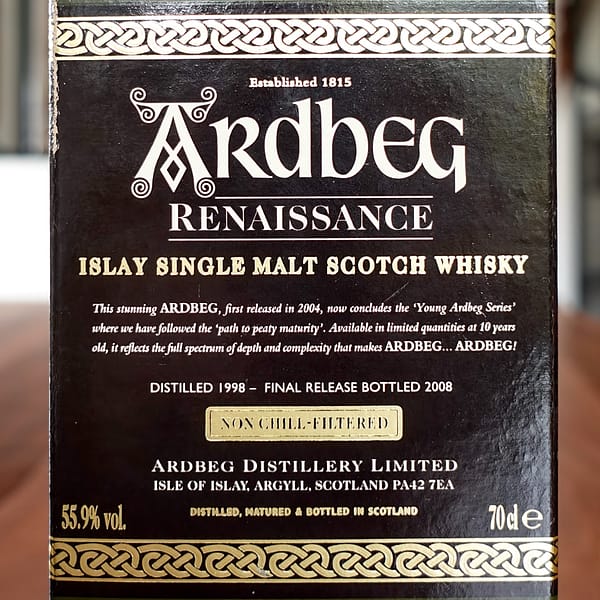
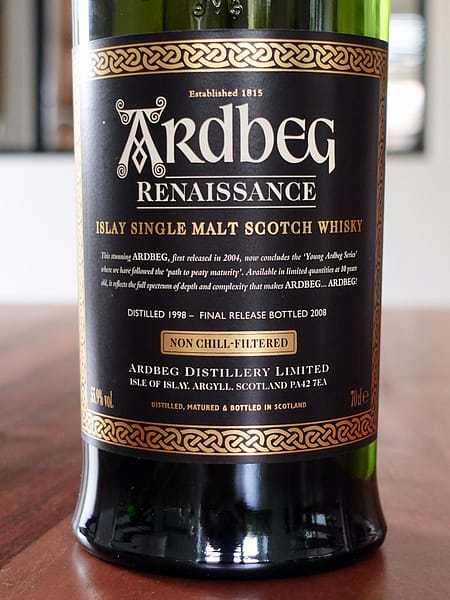
Specs
Price paid: £50, at release in 2008 – Only available at auction (150-200€) or through selected shops at significantly inflated prices
Lot/bottled date: L8 121, distilled 1998 bottled 2008
ABV: 55.9%
Natural colour: not stated, but presumably so
Non-chill filtered: Yes
Casks Used: Not stated, but likely mostly ex-Bourbon and refill
Tasting Notes
Colour: A lovely bright gold. Although no statement is present on the bottle or box regarding the addition of caramel colouring, it is hard to imagine that any was used.
Nose: Smells incredibly mellow for its ABV and for being an Ardbeg. There is a gentle maritime peat note that veers into a marine and mineral crushed seashells note. Then, bright lemon peel, some pepper. At the same time, there is a lot of ripe fruit: apples, ripe melon, maybe even a little gooseberry. Some liquorice and a lick of BBQ meat. As it breathes in the glass, there is even some marmalade.
Adding water reveals a lot more citrus, and a floral note emerges. Together, it almost reminds me of bergamot. The peat and pepper are still there, even tamer now, but now also more barley-driven notes: porridge, grain chaff.
Taste and finish: On the palate, it is a completely different story. It transforms into a more familiar Ardbeg character. The ABV is noticeable with its warming effect, and the peat is anything but shy. It’s rich and oily, punchy. Definitely more recognisable as Ardbeg, with pepper, liquorice, and peat. And yet it has a gentler vein. There is a light floral note, maybe iris blossom. Then, some spirit character, rich with malt notes and vanilla syrup.
With water, it turns into a more familiar and classic Ardbeg character, peaty and spicy, with golden syrup and liquorice. Funnily enough, the extra water dilutes out that gentler streak
The finish is medium-long, peaty, a bit spicy (pepper and ginger), with citrus peel, and a lot of mineral chalkiness, immediately taking me to wet pebbles on the beach
Adding water turns it into a more linear finish, peaty, maritime, citrusy.
Score: 8/10
There are a few layers to my vote today. The main one is purely for the quality of the whisky. As much as I am not a fan of the constant Ardbeg stream of releases and the stupid pricing they often have, I cannot ignore the quality of their bottles. I have scored both the 10-year-old and the Uigedail quite highly in the past. The Renaissance is an intriguing bottle.
When I set off to review this Ardbeg Renaissance, I had two goals in mind. The first one was to understand if the Ardbeg style had changed in the past 17 years. Some whisky fans complain that this has been the case and that the original bottlings were better. Better or worse is always a personal judgement, so that mileage will inevitably vary. Style, on the other hand, is somewhat more objective. After trying the Renaissance, I would say the style has changed, but only somewhat.
I found the palate to be quite true to what Ardbeg is today. What is different is the nose, much softer and welcoming than the Ardbeg expressions from 2022 onwards which I have tried. Overall, the result is a very tasty Islay dram which I am glad to have bought back in 2008
Which brings me to the second goal. To give a fair assessment of the current auction price, that is, whether it is worth going after this on the secondary market. If you are an Ardbeg fan, I would say yes, maybe not at 200€, but if you can find a bottle at 150€ or less, it is a piece of distillery history worth having. If you are not an Ardbeg loyalist, unless you find it below 100€, I would rather use the money for one of the many peated gems being released in 2025 at more affordable prices.
* Scores are based on the scoring scale used by Dramface, slightly modified to allow half-points
If you have enjoyed this content, please share a comment below and consider supporting the cost of this blog via the button below
After writing my tasting notes, I always find it interesting to look at other opinions. Here are a few other reviews of Ardbeg Renaissance I enjoyed:
Interested in my take on a specific whisky style? Check the full Journey here and jump to the relevant Chapter.